
Why Michigan Is the Global Hub for Automotive Parts Manufacturing
From Detroit's century-old forge shops to the state's modern CNC precision facilities, Michigan isn't just part of the automotive supply chain — it is the supply chain.
Michigan's annual automotive output
Tier 1 automotive suppliers in state
Automotive manufacturing jobs in Michigan
Michigan's Century-Long Automotive Legacy
When Henry Ford opened his Highland Park plant in 1910, he didn't just build cars — he built an ecosystem. Within two decades, hundreds of suppliers, forge shops, stamping plants, and machining houses had clustered around southeast Michigan, creating a gravitational pull that still defines global automotive sourcing today.
That legacy isn't nostalgia. It's infrastructure. Michigan is home to more automotive engineers per capita than any other state, more automotive R&D investment than any country outside Germany and Japan, and a supplier density that no other geography can replicate. For OEMs sourcing Tier 1 automotive supplier components, the concentration of qualified manufacturers within a 150-mile radius of Detroit represents a logistics and co-development advantage that is structurally impossible to offshore.

Photo by Emily Rose Bennett / MLive. All Rights Reserved.
"Michigan doesn't have an automotive industry. Michigan is the automotive industry, and its supplier base is the reason why."
Cold Forged Automotive Components: Michigan's Precision Advantage
Cold forging is one of the most demanding processes in automotive manufacturing — and Michigan's forging corridor, stretching from Detroit through Flint and into mid-Michigan, is among the most concentrated in the world. A qualified forged automotive parts manufacturer in Michigan brings decades of metallurgical knowledge and capital-intensive press infrastructure that takes years and hundreds of millions of dollars to establish elsewhere.
Cold forged automotive components offer OEMs critical advantages: near-net-shape accuracy that reduces secondary machining costs, superior grain flow that dramatically improves fatigue life, and material savings of 15–30% over machined-from-billet alternatives. For safety-critical applications like steering knuckles, control arms, transmission shafts, and wheel hubs — cold forging isn't a preference. It's a requirement.
- ⇒Steering and suspension: Tie rod ends, ball joints, and knuckles cold forged to net or near-net shape with fatigue lives exceeding OEM specifications by 40%+.
- ⇒Powertrain shafts: Input and output shafts, pinion gears, and axle components where grain structure integrity is non-negotiable.
- ⇒Fasteners and structural inserts: High-strength cold forged fasteners for chassis and body-in-white applications, replacing lower-grade machined alternatives.
- ⇒EV-specific hardware: Battery tray fasteners, motor housings, and high-voltage connector bodies increasingly specified as cold forged for weight and strength targets.
Why source cold forged components from Michigan? Michigan-based forged automotive parts manufacturers maintain IATF 16949 certification, full PPAP capability, and established relationships with domestic steel mills — reducing lead time risk and supply chain exposure compared to offshore forging sources.
CNC Machined Automotive Parts: Precision at Scale
If forging is Michigan's heritage, CNC machining is its present-tense competitive advantage. The state's CNC machined automotive parts ecosystem spans everything from high-volume transfer-line production for powertrain housings to low-volume 5-axis precision work for prototype and specialty programs.
Michigan's CNC machining shops have evolved alongside automotive precision requirements — tolerances that were considered aerospace grade a decade ago are now standard OEM specs for EV motor components and battery thermal management hardware. Sourcing CNC machined automotive parts from Michigan-based manufacturers means access to:
- ⇒Multi-axis machining centers capable of holding ±0.0005" tolerances on complex aluminum and steel housings.
- ⇒In-process CMM verification integrated into production cells — not just end-of-line inspection.
- ⇒Experienced process engineers who have machined the same component families for 20–30 years and carry institutional knowledge no manual can replace.
- ⇒Rapid prototype-to-production transition capability, critical for OEM programs with aggressive gate timelines.
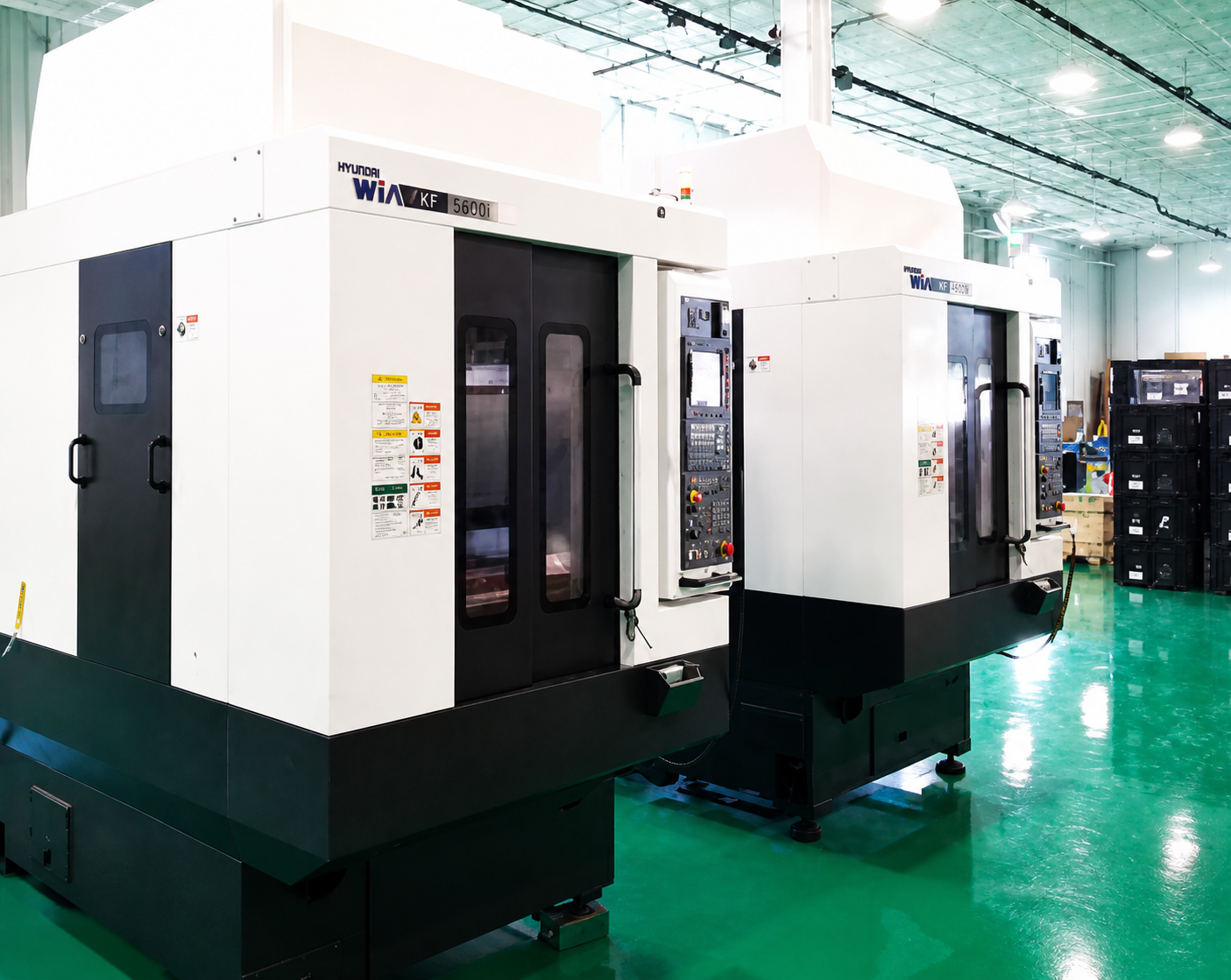
Hyundai Wia CNC Machine at Marimba Auto. All Rights Reserved.
Automotive Metal Stamping in Michigan: The Backbone of Body-in-White
No process is more synonymous with Michigan automotive manufacturing than metal stamping. The state's automotive metal stamping manufacturers operate some of the largest presses in North America, progressive die lines running 24/7 to supply body panels, structural reinforcements, brackets, and closures to assembly plants across the region.
Modern automotive metal stamping in Michigan has advanced far beyond simple sheet forming. Today's leading manufacturers work with advanced high-strength steels (AHSS), hot-stamped boron steel for crash-critical structures, and aluminum stampings for weight reduction programs. Michigan accounts for more than 28% of all North American automotive stamping production by volume.
- ⇒Body-in-white stampings: A-pillars, B-pillars, rocker panels, floor pans, and crossmembers in AHSS and dual-phase steels up to 1500MPa.
- ⇒Closure panels: Hoods, doors, liftgates, and fenders with Class A surface requirements and tight hem flange tolerances.
- ⇒Structural brackets and reinforcements: Mounting brackets, engine cradle components, and seat structure stampings in complex geometries.
- ⇒EV battery enclosure structures: Aluminum and high-strength steel stampings for battery tray floors, side members, and thermal barrier components.
Michigan's EV Transition: Suppliers Leading the Next Chapter
The shift to electric vehicles has not weakened Michigan's automotive manufacturing position — it has accelerated investment into it. The state has attracted major commitments from Ford's BlueOval City supply chain, GM's Ultium battery ecosystem, and a wave of new entrants requiring EV-specific component sourcing from qualified, IATF-certified manufacturers.
Michigan-based Tier 1 automotive suppliers are actively retooling cold forging lines for EV motor shaft production, adding 5-axis CNC capacity for battery enclosure machining, and investing in aluminum stamping capability for lightweighted EV structures. The infrastructure transition is happening faster in Michigan than anywhere else in North America because the workforce, the equipment base, and the engineering talent are already here.
"EV manufacturing doesn't replace the Michigan supplier base — it validates it. Every EV still needs forged shafts, machined housings, and stamped structures. Michigan makes all of them."
How to Find the Right Michigan Automotive Parts Manufacturer
With hundreds of qualified manufacturers operating across the state, identifying the right partner for your specific component category requires a structured approach. Whether you need cold forged automotive components, CNC machined parts, or high-volume metal stampings, use this evaluation checklist:
- Confirm current IATF 16949 certifications — request the certificate number and verify it against the IATF global registry.
- Validate process-specific capability: forging tonnage range, CNC axis count, press capacity — not just general IATF compliance.
- Request PPAP documentation from a comparable prior program in the same material and process family.
- Assess proximity to your Michigan or Midwest assembly operations — JIT delivery windows under 4 hours are realistic from most Michigan locations.
- Evaluate engineering co-development capability: do they have DFM engineers, in-house CAD/CAE, and prototype tooling capacity.
- Check sub-tier supply chain — are their steel and aluminum sources domestic, dual-qualified, and free of conflict mineral exposure.
What Makes Michigan the Preferred Location for Tier 1 Suppliers
Michigan hosts the North American headquarters or primary manufacturing operations for dozens of the world's largest Tier 1 suppliers — all within state.
Michigan produces more automotive engineers annually than any comparable region — feeding a workforce with deep process expertise across forging, machining, and stamping disciplines.
GM, Ford, and Stellantis headquarters are all within 30 miles of each other. Supplier proximity reduces co-development friction dramatically and enables rapid engineering response.
Decades of capital investment in press shops, forge lines, heat treat facilities, and CNC cells that can't be recreated overnight — or for under hundreds of millions of dollars — anywhere else.
Freeway, rail, and Great Lakes port access enables JIT delivery to assembly plants across the Midwest and Canada within hours — a competitive advantage no coastal state can match.
Michigan's workforce and legal environment have evolved alongside automotive regulation — CAFÉ standards, EPA compliance, FMVSS — for generations. Compliance is institutional, not learned on the fly.
The state has attracted over $20B in EV and battery manufacturing investment since 2021, positioning Michigan-based suppliers at the forefront of the next platform cycle.
Companies like Marimba Auto exemplify why Michigan continues to lead global automotive manufacturing — combining deep process expertise in cold forging, CNC machining, and metal stamping with IATF 16949-certified quality systems and full production transparency. For OEMs, that translates into faster program launches, tighter tolerances, and a supplier base built for long-term platform success.
Ready to source precision automotive components from Michigan's most capable manufacturer?
Get in touch →



