
Why is PPAP Important in Automotive Manufacturing?
Documented elements in a full PPAP package
Submission levels, with Level 3 the default
Rejection cause: incomplete or inconsistent documentation
What is PPAP and Why Is It Important?
PPAP, the Production Part Approval Process, is the automotive industry's standardized way of proving — before full production begins — that a supplier's process can consistently make parts meeting every engineering requirement. It answers one blunt question: not "can you make a good sample?" but "can your actual production line produce conforming parts, every time?" That distinction is why PPAP matters. Catching a process problem before first delivery costs a fraction of catching it after thousands of parts ship. Explore our quality and validation process to see how it works in practice.
"PPAP isn't paperwork for its own sake. It's the moment a supplier proves the process — not a prototype — can be trusted at full rate."
Where PPAP Comes From?
PPAP was developed by the Automotive Industry Action Group (AIAG) and is defined in the AIAG PPAP manual, now in its 4th edition. It is referenced directly in IATF 16949 as a customer-specific requirement, which means virtually every major OEM — Ford, GM, Stellantis, Toyota — and the Tier 1 suppliers beneath them expects it. The AIAG manual is the floor, not the ceiling: most OEMs layer their own requirements on top.
The 18 Elements of PPAP
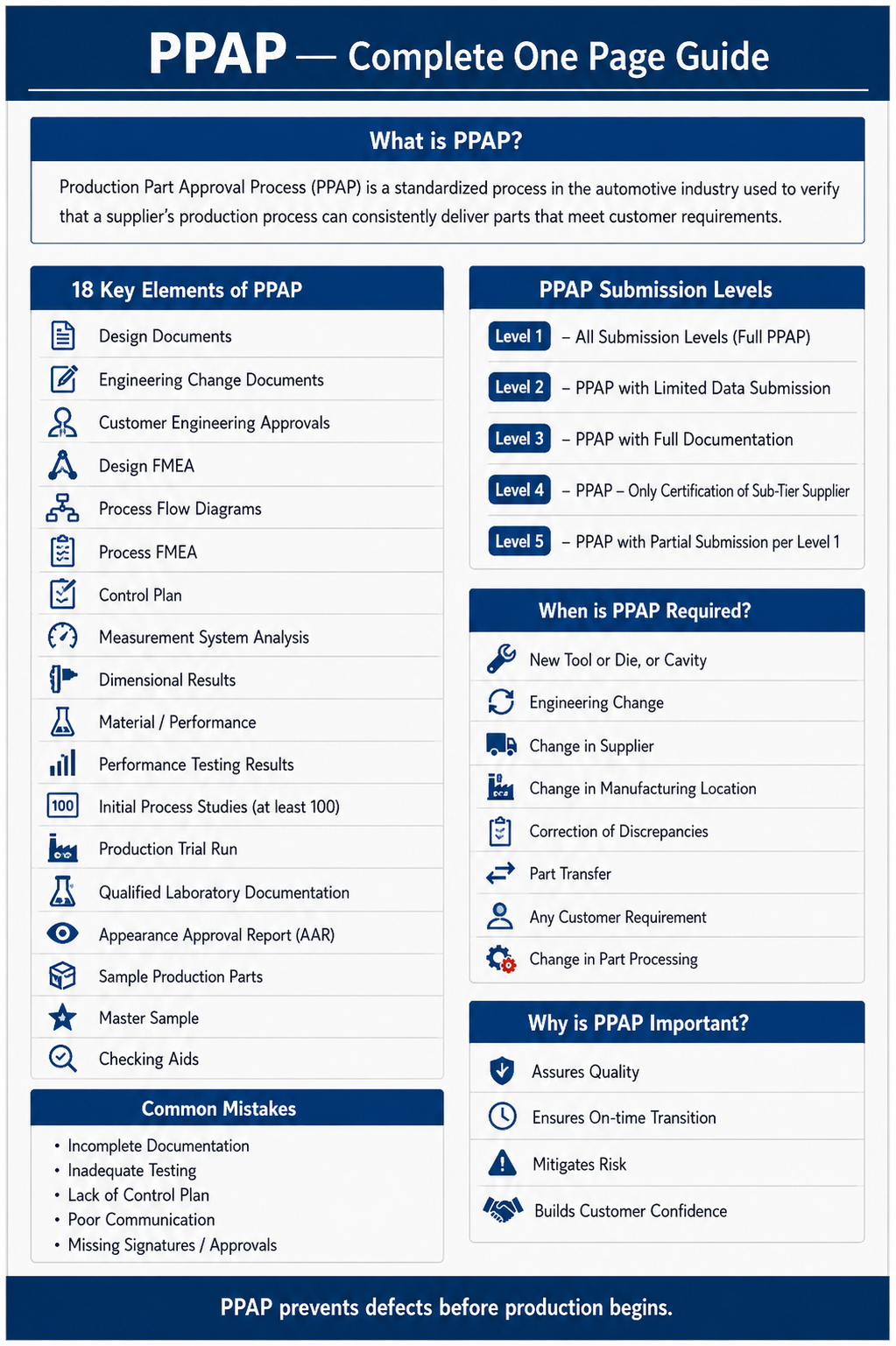
Complete PPAP Guide
A complete PPAP package assembles up to 18 documented elements — largely the deliverables produced during Advanced Product Quality Planning (APQP):
- Design records
- Engineering change documents
- Customer engineering approval
- Design FMEA (DFMEA)
- Process flow diagram
- Process FMEA (PFMEA)
- Control plan
- Measurement system analysis (MSA)
- Dimensional results
- Material and performance test results
- Initial process studies (Cpk)
- Qualified laboratory documentation
- Appearance approval report (AAR)
- Sample production parts
- Master sample
- Checking aids
- Customer-specific requirements
- Part Submission Warrant (PSW)
Not every element is physically submitted every time — the customer sets the submission level — but each must be completed and retained. The PSW is the cover sheet certifying the whole package.
Why PPAP is Required
Five reasons PPAP is treated as a formal gate rather than a paperwork exercise.
It creates a formal gate where process capability must be proven before delivery, catching problems when they're cheapest to fix.
Initial process studies (Cpk) show the process holds tolerances repeatably — not just on a hand-built sample.
Documented records tie every characteristic to a control method and a responsible owner.
A shared framework lets OEM and supplier speak the same quality language across borders.
Under IATF 16949, PPAP is effectively mandatory for new or changed parts and processes.
The Five PPAP Submission Levels
PPAP is not one-size-fits-all. The customer specifies one of five levels based on part risk and supplier history:
- Level 1: Part Submission Warrant (PSW) only
- Level 2: PSW with samples and limited data
- Level 3: The default for new tooling — submits the full data package
- Level 4: Follows customer-defined requirements
- Level 5: Keeps the complete package available for review at the supplier's site
The level determines what's sent versus retained — never whether the work gets done.
When Is PPAP Required?
A PPAP is required for a new part, an engineering change, a new or significantly changed production process, a new supplier or location, or a resumption after a production pause. Whenever the process that makes the part changes, the evidence that it still produces conforming parts has to be renewed.
Frequently Asked Questions
Click any question to expand the answer.
PPAP, the Production Part Approval Process, is a standardized method that proves a supplier's production process can consistently make parts meeting engineering requirements. It matters because it catches process problems before mass production, when they're far cheaper to fix.
They range from design records, DFMEA, and PFMEA to control plans, MSA, dimensional results, Cpk studies, sample parts, and the Part Submission Warrant — the deliverables that together prove process capability.
It is referenced in IATF 16949 as a customer-specific requirement, so major OEMs require it to prevent risk, ensure repeatable quality, and maintain traceability before accepting production parts.
PPAP was developed by the Automotive Industry Action Group (AIAG) and is defined in the AIAG PPAP manual, currently in its 4th edition.
Level 1 is the PSW only; Level 2 adds samples and limited data; Level 3 (the default) submits the complete package; Level 4 follows customer-specified requirements; Level 5 keeps the full package available for review on-site.
For new parts, engineering changes, new or changed production processes, a new manufacturing location, or resuming production after a significant pause.
Need a supplier who submits complete, on-time PPAP documentation for every program? Contact us for your RFQ.
Request an RFQ →



