
Why Do OEMs Use Carpeted Hardboard Automotive Assemblies in Modern Vehicle Interiors?
Fuel-efficiency gain from a ~10% cut in vehicle weight
Source: Plastics Engineering
Lighter: fiber-based interior panels vs. molded plastic
Source: BASF
Every interior program balances weight, cost, and the tactile quality a buyer registers the instant they open a door. Carpeted hardboard automotive assemblies sit at that intersection, which is why OEMs spec them across load floors, package trays, seat backs, and trunk trim. The weight stakes are real: trimming vehicle mass by roughly 10% can lift fuel efficiency by about 7%, so every panel is scrutinised. As an established automotive component manufacturer, Marimba Auto treats these parts as quiet workhorses — rarely advertised, present in almost every vehicle. For the wider portfolio, see our interior systems overview.
"The best interior components are the ones a driver never notices — structural enough to carry load, soft enough to finish a surface, light enough to help the whole vehicle move efficiently."
What Exactly Is a Carpeted Hardboard Assembly?
What Is the Substrate?
Hardboard is a dense, engineered wood-fiber panel formed under heat and pressure. It delivers rigidity and dimensional stability at low weight and low tooling cost relative to molded plastics — making it the default substrate for interior panels that must be both structural and cost-efficient at OEM production volumes.
What Does the Carpet Add?
A bonded carpet or non-woven facing gives the panel its finished, acoustic, and abrasion-resistant surface — turning a structural board into a customer-facing trim piece that can withstand years of loading, unloading, and contact wear.
Where Do They Appear?
Trunk and cargo load floors, rear package trays, seat-back panels, wheel-arch trim, and parcel shelves — anywhere the program needs a surface that is simultaneously structural, finished, and lightweight.
How Do They Compare to Alternatives?
The wider shift toward lighter interiors backs this up. Fiber-based panels can be around 40% lighter than conventional injection-molded plastic, and the material family already runs at scale across major OEM lines.
| Material Approach | Weight | Tooling Cost | Acoustic Value | Best Fit |
|---|---|---|---|---|
| Carpeted hardboard | Low–medium | Low | High | Load floors, package trays |
| Injection-molded plastic | Medium | High | Low–medium | Complex 3D geometry |
| Compression-molded composite | Low | Medium–high | Medium | Structural seat backs |
| Bare fiberboard | Low | Low | Low | Hidden / non-visible areas |
Five Reasons OEMs Keep Specifying Them
This breadth is why an automotive parts manufacturer treats the carpeted board family as a platform — and why a dedicated automotive seating components supplier engineers seat-back boards to crash and stowage standards.
Board substrates avoid the expensive tooling molded parts demand — decisive for any OEM automotive parts supplier quoting high-volume programs. Lower tooling investment means faster amortization and better unit economics across the full production run.
Lighter panels support fuel-economy and range targets — core to what an automotive structural components manufacturer brings to a platform. Fiber-based panels run approximately 40% lighter than conventional injection-molded plastic alternatives.
The carpet facing dampens cabin noise and lifts perceived quality — a measurable differentiator that registers with every customer who opens a door or loads the boot.
Boards accept a wide range of carpet colours, textures, and die-cut shapes for fast model-year refreshes — without the lead time or tooling investment that molded plastic reskins require.
Wood-fiber substrates use renewable, recyclable content as OEMs tighten material-sourcing standards globally. Mercedes-Benz integrated natural fibers such as flax, hemp, sisal, and wool into roughly 50 components of the E-Class.
At-a-Glance: Where These Assemblies Do the Work
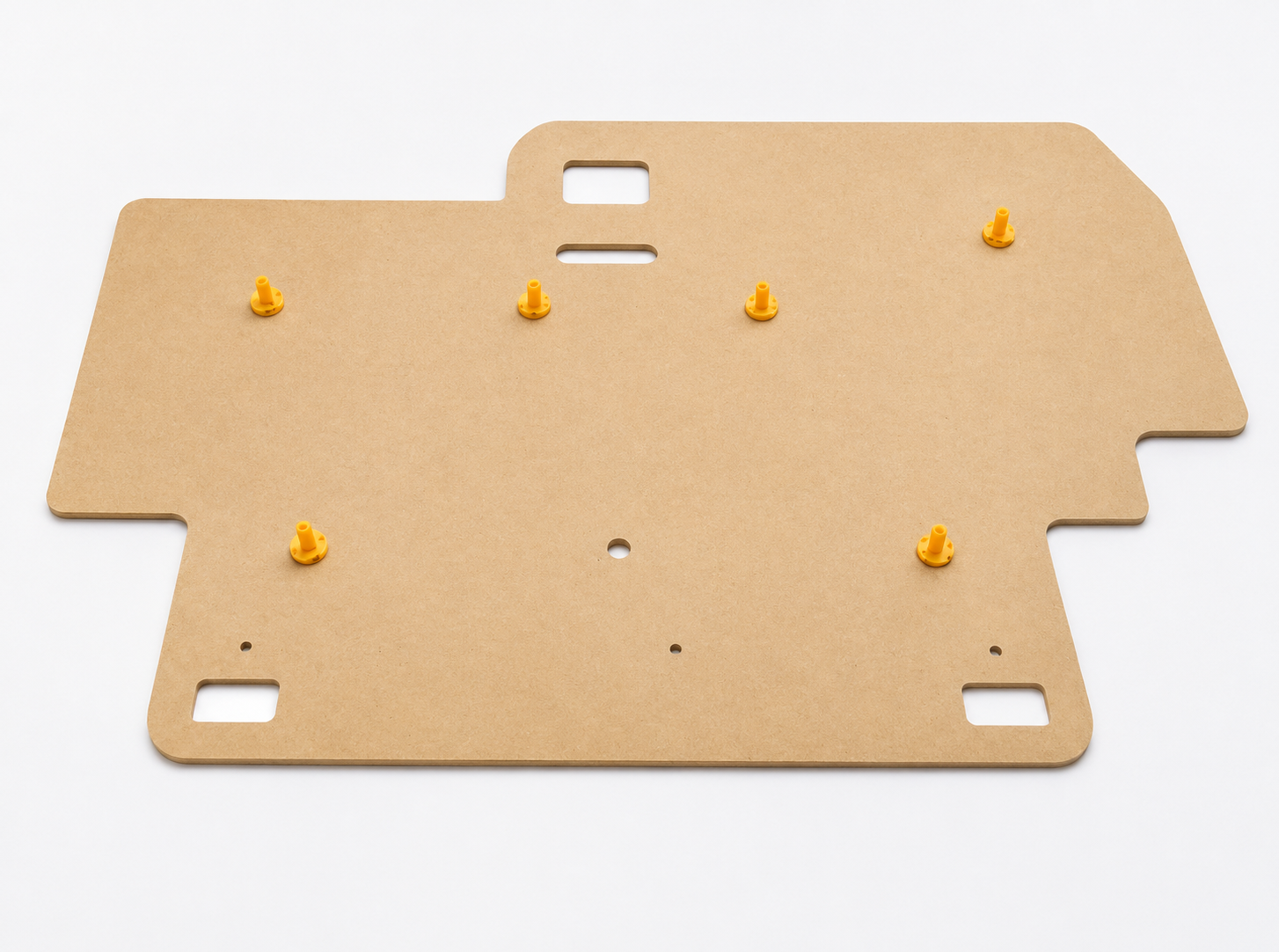
Marimba Auto manufactures automotive cardboard components in-house using a 350-ton press, supporting OEM and Tier 1 suppliers with high-quality interior trim and cargo area solutions. All rights reserved. Marimba Auto LLC.
| Application | Primary Function | Why Hardboard Wins |
|---|---|---|
| Trunk load floor | Bears cargo weight | Rigid yet light |
| Rear package tray | Houses speakers, hides cargo | Acoustic + clean finish |
| Seat-back panel | Structural backing + trim | Strength-to-weight ratio |
| Wheel-arch trim | Covers and quiets | Conforms to contours |
What Changes With EVs?
Electric vehicles intensify every reason above. Range pressure makes weight reduction non-negotiable, and the missing combustion engine raises the bar for cabin quietness — road and structural noise become far more noticeable. Carpeted hardboard assemblies answer both pressures at once.
The lightweighting trend is already visible across interiors: automakers have moved natural fibers into roughly 50 components on a single model line. EV "frunks" and reconfigurable cargo areas also demand more board-based load floors and dividers, expanding the role these parts play across the full vehicle architecture.
As battery packs shift the centre of gravity and redistribute interior space, the load floor and cargo management structures that carpeted hardboard assemblies form become more complex — and more structurally important — than their ICE equivalents. This is where early co-development with a qualified automotive component manufacturer delivers the most program value.
Marimba Auto designs, tools, and validates carpeted hardboard assemblies for OEM programs worldwide — pairing structural engineering with finish-quality trim. Explore our capabilities →
Frequently Asked Questions
Click any question to expand the answer.
Yes. Properly sealed boards resist warping, and the carpet facing protects against abrasion over the vehicle's life. When specified and manufactured to OEM tolerances, these assemblies routinely outlast the vehicles they are installed in.
The wood-fiber substrate is recyclable and facing separation technology continues to improve. As sustainability requirements tighten under EU end-of-life vehicle regulations, the recyclability advantage of fiber-based substrates over molded plastics becomes increasingly significant.
Established interior specialists like Marimba Auto engineer, tool, and validate these parts to OEM specifications — managing the full process from substrate selection and die design through PPAP submission and production launch.
Die and press tooling for carpeted hardboard assemblies is significantly faster and lower cost than injection-mold tooling — typically 4–8 weeks for new dies versus 12–20 weeks for comparable molded plastic tooling. This makes hardboard the preferred choice for model-year refreshes and platform derivatives where speed to production matters.
IATF 16949 certification is the baseline — but confirm the scope explicitly covers interior trim and pressing operations at the relevant production site. Full PPAP capability, material traceability, and in-process dimensional verification are equally non-negotiable for any OEM-grade interior assembly program.
Need a qualified partner for carpeted hardboard assemblies or interior trim? Talk to Marimba Auto.
Get in touch →



