
The Complete Guide to Quality Assurance in Automotive Component Manufacturing
IATF 16949 certified sites worldwide as of September 2025
U.S. vehicles recalled in 2024 across 1,073 safety recalls
An OEM warranty claims spend, up 22% year over year in 2024
What Is Quality Assurance in Automotive Manufacturing?
A single defective component can trigger a recall that costs an automaker billions and erodes a brand built over decades. That risk is why quality assurance sits at the center of every OEM–supplier relationship in this industry. For a component manufacturer, quality is not a department or a final inspection step. It is a documented system governing how parts are designed, produced, measured, and released.
Automotive quality assurance is the systematic set of processes a supplier uses to prevent defects before they occur, rather than catching them afterward. It spans raw material sourcing, tooling validation, in-process measurement, operator training, and full lot traceability. Every element exists to answer one question a customer will eventually ask: can you prove this part was made right?
Quality Assurance vs. Quality Control
Quality control is the inspection activity — gauging a bore diameter, running a hardness test, checking a weld. Quality assurance is the framework that determines which characteristics get measured, how often, by whom, and what happens when a reading starts to drift. Control catches the bad part. Assurance prevents the next one.
"Inspection tells you what happened. A quality system tells you what will happen next — and that is what an OEM is actually buying."
The Automotive Quality Standards That Define the Industry
IATF 16949: The Baseline Certification
IATF 16949 is the global quality management standard for automotive production and service part organizations. Built on the ISO 9001 process framework, it layers on automotive-specific requirements for defect prevention, variation reduction, and waste elimination across the supply chain. Certification has become a practical prerequisite rather than a differentiator — most OEMs and Tier 1 buyers will not add a supplier to an approved list without it, and clause 8.4.2.3 pushes the same expectation down to sub-tier suppliers.
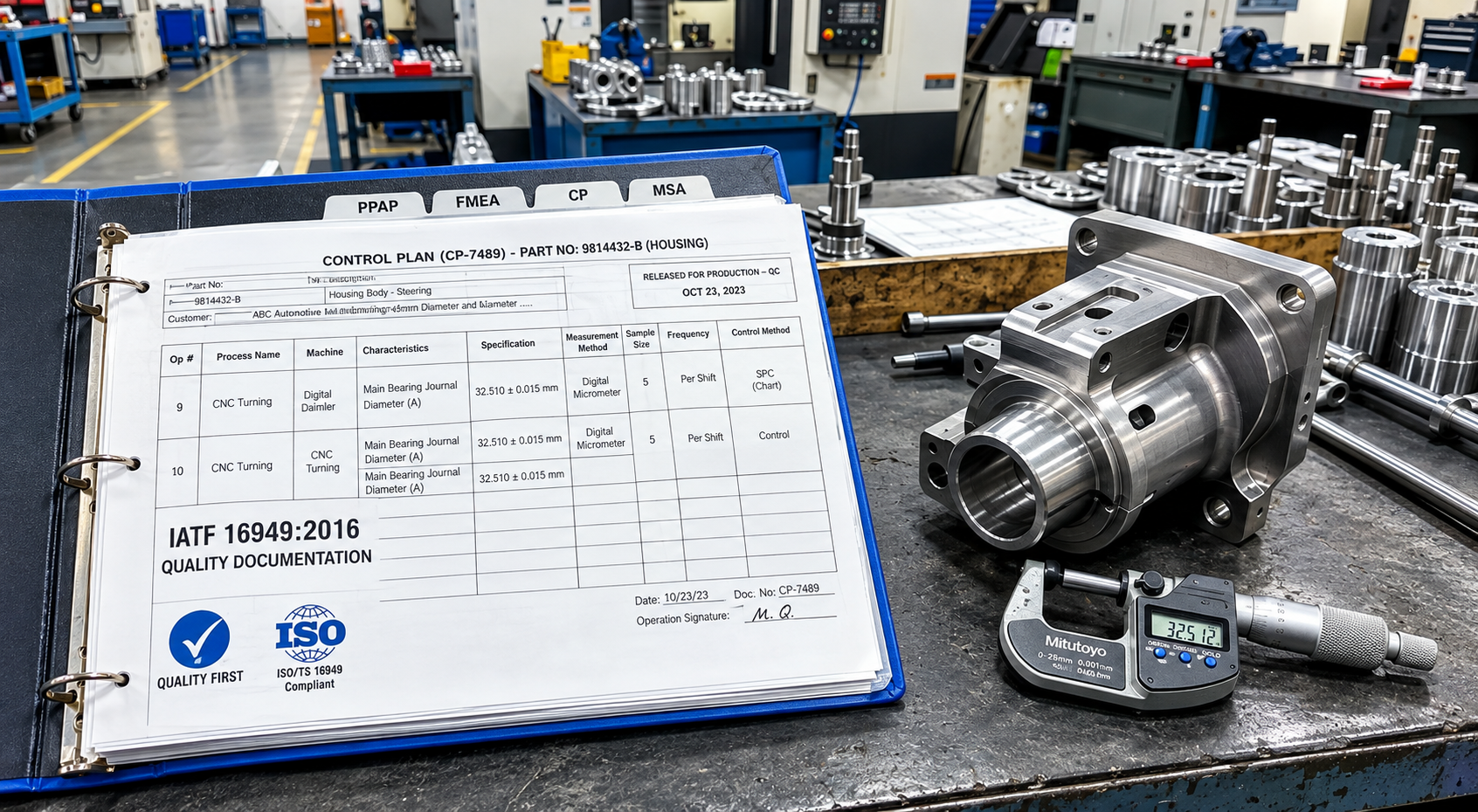
Close-up of a control documentation binder alongside a measured part.
The Five AIAG Core Tools
A certificate means little without the disciplines underneath it. Five core tools carry most of the load.
Structures product development from concept through launch.
Identifies failure modes and ranks them by risk before tooling is cut.
Confirms the measurement system itself is capable and repeatable.
Monitors process variation while the job is running.
Packages the evidence that a process can produce conforming parts at volume. Our guide to PPAP in automotive manufacturing walks through all 18 elements.
How Quality Assurance Works on the Production Floor
On a forging line or a CNC cell, quality assurance shows up as control plans tied to specific characteristics. Critical dimensions are flagged during FMEA, assigned inspection frequencies in the control plan, and tracked on X-bar and R charts at the machine. Operators are trained to react to a trend, not just an out-of-spec reading.
Layered process audits verify the plan is actually being followed. First-article inspection confirms a setup before the run releases. Gauge calibration schedules keep the measurement system honest. And full lot traceability means that if a nonconformance surfaces at the customer, containment happens in hours instead of weeks. Marimba Auto's in-house forging, CNC machining, stamping, and tube forming operations run under a single IATF 16949–certified quality system, which keeps control plans consistent as a part moves between processes.
What OEMs and Tier 1s Expect From a Component Supplier
Buyers evaluate on evidence, not claims. The same questions surface in nearly every sourcing review:
- A current IATF 16949 certificate with the correct registered scope
- Documented PPM defect performance and on-time delivery history
- Capability indices on critical characteristics, typically Cpk ≥ 1.33
- A closed-loop corrective action process, usually 8D with verified effectiveness
- Controls extended to sub-tier suppliers and outsourced processes
Warranty exposure explains the scrutiny. When a single OEM absorbs billions in claims in one year, the cost of a supplier quality escape is measured in far more than scrap. Working with an IATF 16949 certified manufacturer like Marimba Auto shifts that risk conversation from assurances to documented, auditable process capability.
Frequently Asked Questions
Click any question to expand the answer.
Automotive quality assurance is the documented system a supplier uses to prevent defects before they occur. It covers material sourcing, tooling validation, in-process measurement, operator training, and lot traceability — as opposed to quality control, which is the inspection activity that catches defects after they happen.
ISO 9001 is a general quality management standard applicable to any industry. IATF 16949 is built on that foundation and adds automotive-specific requirements around defect prevention, variation reduction, product safety, and supply chain controls. An automotive supplier generally needs IATF 16949, not ISO 9001 alone, to be approved by an OEM or Tier 1.
Certification gives an OEM auditable proof that a supplier's processes are capable and controlled, which reduces the risk of a field failure, a warranty claim, or a recall. IATF 16949 also requires certified organizations to push comparable requirements onto their own sub-tier suppliers, extending control down the chain.
APQP for product development planning, FMEA for risk analysis, MSA for measurement system validation, SPC for monitoring process variation, and PPAP for submitting evidence that a production process can make conforming parts at volume. They are published by AIAG and are referenced throughout IATF 16949.
Most automotive customers expect a minimum Cpk of 1.33 on critical and significant characteristics, with 1.67 or higher required during initial PPAP submission or on safety-related features. Specific targets are set by each customer's requirements.
Need a supplier that builds quality in under a certified IATF 16949 system? Contact us for your RFQ.
Request an RFQ →



