
Why Aluminum Die Castings Are the Preferred Choice for High-Performance Automotive Components?
Fuel-economy gain from a 10% reduction in vehicle weight
Source: Alcoa
Drop in EV energy consumption from a 10% mass reduction
Source: SAE
Aluminum's density relative to steel (~2.7 g/cm³)
Why This Matters
High-performance components live under a hard constraint: they must be strong, thermally stable, and dimensionally exact — while weighing as little as possible. Aluminum die castings answer all three at once, which is why they now dominate housings, brackets, and structural nodes across performance and electrified platforms. The math is direct: an Alcoa study found a 10% cut in vehicle weight improves fuel economy by 5–7%, and SAE research shows a 10% mass reduction lowers EV energy consumption by 8.7%. Every gram compounds. See our precision manufacturing capabilities.
"Die casting doesn't win on price per kilogram. It wins on what you stop having to do afterward — fewer parts, fewer joints, fewer machining hours."
What Are Aluminum Die Castings?
How Does the Aluminum Die Casting Process Work?
Molten aluminum is injected into a hardened steel die under high pressure, producing a near-net-shape part with tight tolerances and smooth surfaces in a single cycle. High-pressure die casting (HPDC) is the dominant automotive variant.
What Makes Them "Precision"?
Precision aluminum die castings hold repeatable geometry straight from the die, then reach final tolerances through targeted CNC machining of critical features rather than machining the entire part from billet.
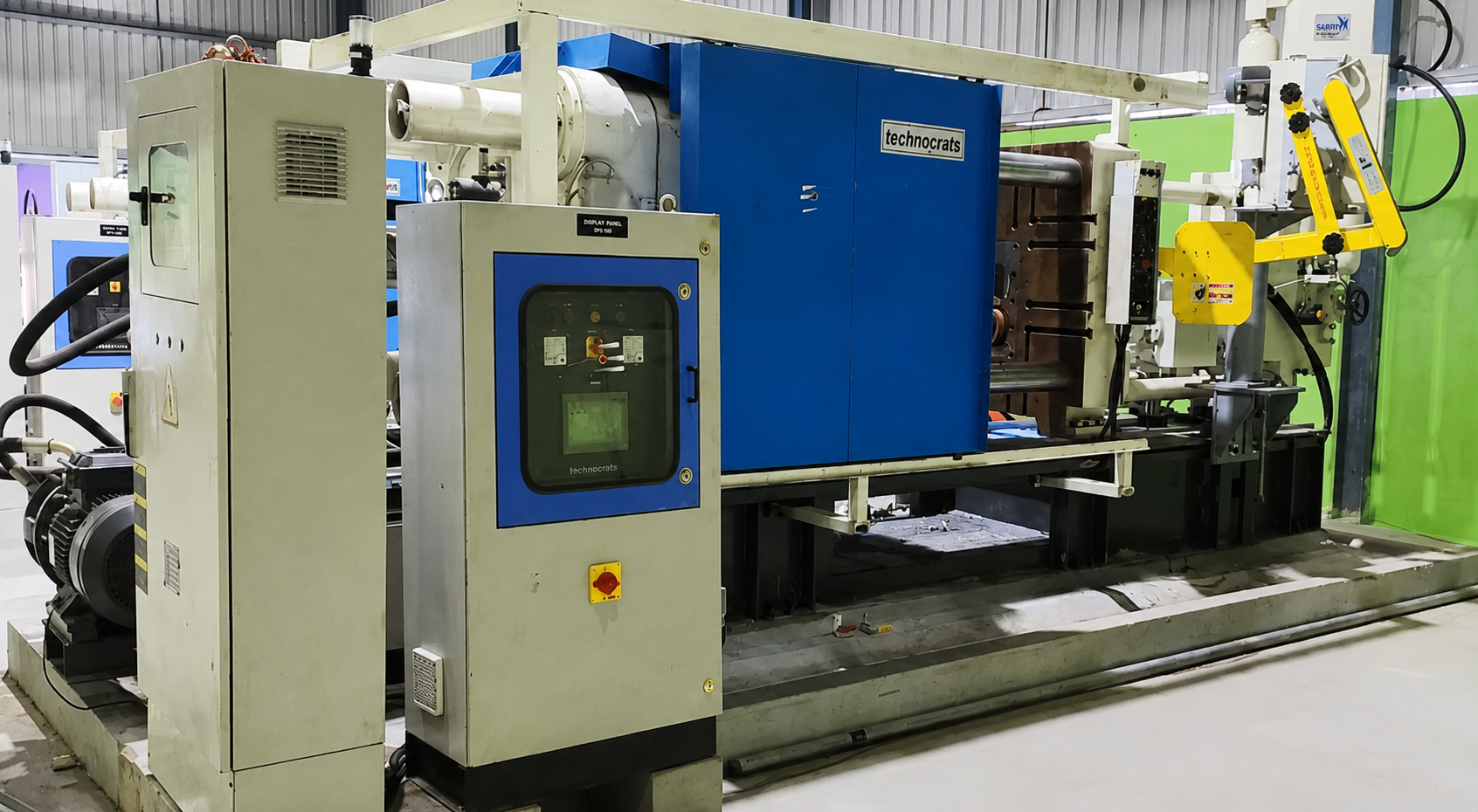
600 Ton Aluminum Die Casting Machine (HPDC)
How Do Aluminum Die Castings Compare to Steel?
Aluminum's density is roughly one-third that of steel at about 2.7 g/cm³. Cast geometry lets engineers place material only where load demands it — ribs for stiffness, thicker bosses at mounting points, thinner walls elsewhere — so parts can match steel's functional stiffness at substantially lower mass. Steel still wins on raw tensile strength per unit volume and lower material cost, which is why aluminum earns its place on a per-function basis, not a per-kilogram one. (See ScienceDirect on steel vs. aluminum in lightweight production.)
Five Reasons OEMs Specify Aluminum Die Castings
Each of these advantages maps directly to a design or cost pressure that OEM engineering and procurement teams face on every program.
Lower unsprung and structural weight improves handling, efficiency, and EV range simultaneously.
One casting can replace a multi-piece stamped-and-welded assembly, removing fasteners, welds, and tolerance stack-up.
Internal passages, cooling fins, and mounting features form together in shapes that machining alone can't reach economically.
Aluminum's conductivity suits inverter housings, e-motor cases, and heat-shedding brackets.
Die tooling is a real upfront cost, but it amortizes fast across high-volume programs — making aluminum die casting one of the most cost-effective processes at scale.
Applications of Aluminum Die Castings in High-Performance Vehicles
Engine and transmission housings, turbocharger components, suspension shock towers, brake calipers and brackets, EV motor and inverter housings, and battery-tray structures. Each demands tight tolerances, thermal cycling resistance, and durability under vibration and load.
What to Look for in an Automotive Die Casting Supplier
Evaluate porosity control, alloy expertise, in-house machining and finishing, leak-test capability, PPAP discipline, and IATF 16949 certification. A capable aluminum die casting manufacturer should own the downstream steps too, because a casting isn't finished until it's machined, validated, and passing leak test.
-
✓Porosity control — high-vacuum HPDC matters for weldable or leak-tested parts, where trapped gas porosity compromises structural and sealing integrity.
-
✓Alloy expertise — the right alloy selection for structural, thermal, or cosmetic requirements, including recycled and high-vacuum alloy options.
-
✓In-house machining and finishing — critical faces, bores, and sealing surfaces reach final tolerance through targeted CNC machining under one roof.
-
✓Leak-test capability — validated on-site for parts where sealing performance is a functional requirement, not an afterthought.
-
✓PPAP discipline — proven on comparable programs, with documented control plans and capability studies.
-
✓IATF 16949 certification — verified with scope covering every process and site relevant to your component program.
How Electric Vehicles Are Driving Aluminum Die Casting Innovation?
Electrification accelerates every driver above. Battery mass forces aggressive lightweighting elsewhere, thermal loads from inverters and e-motors demand conductive housings, and mega casting pushes part consolidation to the limit. Expect wider adoption of recycled and high-vacuum alloys as OEMs pair sustainability targets with structural requirements.
Frequently Asked Questions
Click any question to expand the answer.
It's a process where molten aluminum is injected into a hardened steel die under high pressure, producing near-net-shape parts with tight tolerances and complex geometry in a single cycle.
Aluminum is roughly one-third the density of steel, and cast geometry lets engineers place material only where load requires it — delivering comparable functional stiffness at lower mass, with better thermal conductivity.
Yes, when properly engineered. Structural applications typically use specific alloys with heat treatment and high-vacuum casting to control porosity, which is essential for crash-loaded parts.
As-cast tolerances suit most non-critical features; critical faces, bores, and sealing surfaces reach final tolerance through targeted CNC machining after casting.
Look for IATF 16949 certification, porosity and leak-test control, alloy expertise, in-house machining and finishing, and proven PPAP discipline on comparable programs.
Aluminum is highly recyclable and recycled-content alloys are increasingly used in automotive castings as OEMs tighten material-sourcing and sustainability requirements.
Ready to move from as-cast to fully finished, validated components? Request an RFQ from Marimba Auto.
Request an RFQ →



