
Cold Forged Automotive Components: Benefits, Process & Applications
Material utilization in cold forging vs ~50–70% for machining
Of cold forged parts serve the automotive sector
Higher tensile strength: forgings vs equivalent castings
Why Cold Forging Matters in Automotive
Modern vehicles ask a lot of their metal parts: high strength, low weight, tight tolerances, and long fatigue life produced at volumes measured in millions. Cold forged automotive components meet that brief by building strength into the metal's structure rather than cutting shape out of it. The result is a stronger, more consistent, more material-efficient part, which is why forging underpins so much of the drivetrain, chassis, and fastener content in a car. Explore our forging capabilities for the full picture.
"Casting pours a shape. Machining carves one. Forging persuades the metal to become one — and the grain remembers."
What is Cold Forging?
The Process, Step by Step
A ductile metal billet — usually low-carbon or alloy steel, aluminum, or copper alloy — is cut to length, then deformed under high pressure at or near room temperature. In stages of upsetting, extrusion, and coining, the metal flows plastically into a die and takes near-net shape in seconds, with no heating cycle.
What "Cold" Changes Metallurgically
Because the billet never passes its recrystallization temperature, the grain structure isn't reset — it's re-aligned to follow the finished contours. Work hardening during deformation raises yield strength, and the surface emerges harder and smoother than a machined equivalent.
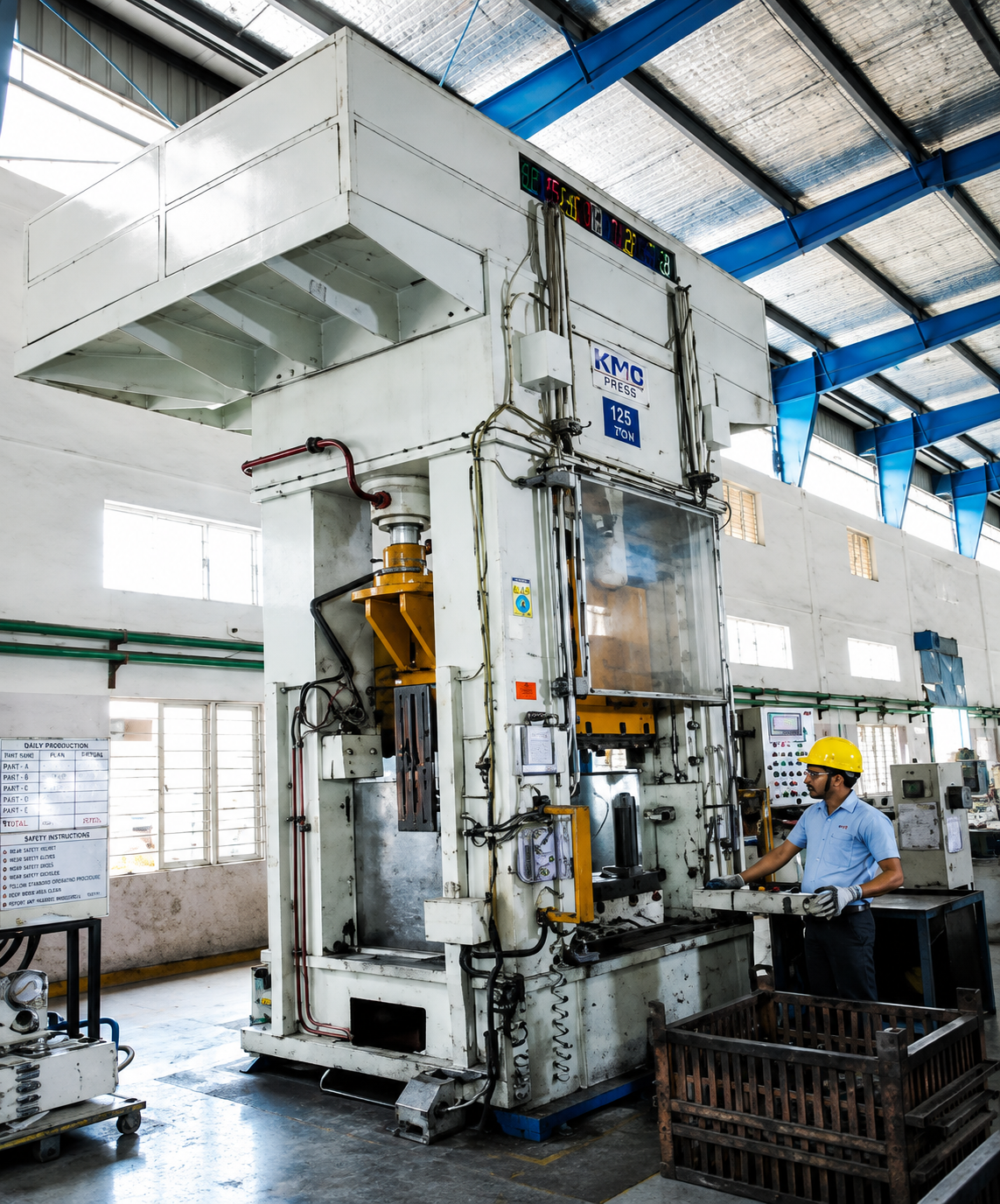
800 TON Press
Benefits of Cold Forged Automotive Components
Six advantages that explain why forging underpins so much of the drivetrain, chassis, and fastener content in a modern vehicle.
Continuous grain flow follows the part geometry, so stress travels along the grain and resists crack initiation — forgings run 20–30% stronger than equivalent castings.
Unlike castings, forgings carry no voids or shrinkage defects to seed a failure.
At 85–95% utilization versus roughly 50–70% for machining, cold forging turns far more of each billet into finished part.
Tight, repeatable tolerances make precision automotive components suited to high-volume production.
Compressive forming improves wear resistance and service life.
Fast cycle times and low scrap amortize tooling quickly across large programs.
Cold Forging vs. Hot Forging vs. Machining
Hot forging heats the billet, unlocking complex or thick geometries and harder-to-form alloys, but with more dimensional scatter. Machining wins on one-off precision, undercuts, and internal threads. Cold forging wins where parts are small-to-medium, volumes are high, tolerances are tight, and loading is cyclic. In practice the strongest results come from combining them: cold forge the blank, then machine only the critical features.
Applications of Cold Forged Automotive Components
Cold forged automotive components are used throughout the car, from driveline systems to steering, fasteners, and engine assemblies.
Gear blanks, pinions, shafts, and constant-velocity joint components.
Bolts, wheel studs, nuts, and cold-headed fittings.
Tie rod ends, ball joint studs, and control-arm hardware — covered in depth in our post on cold forged steering and suspension components.
Valve components, bushings, and anti-vibration parts. Any custom automotive parts manufacturer working to OEM specs relies on forged blanks wherever strength and fatigue life are non-negotiable.
What Changes with EVs?
Electrification retires some engine forgings but adds others: e-drive gear and shaft components, reduction-gear parts, and high-strength fasteners for battery and structural assemblies. As lightweighting pressure grows, expect wider use of forged aluminum alongside steel wherever strength-to-weight is decisive.
Frequently Asked Questions
Click any question to expand the answer.
They are parts shaped from a metal billet under high pressure at or near room temperature — such as gears, shafts, fasteners, and chassis hardware — valued for high strength, fatigue resistance, and tight tolerances.
Continuous grain flow for strength and fatigue life, no internal porosity, high material utilization (85–95%), tight repeatable tolerances, work-hardened surfaces, and strong economics at volume.
A billet is cut to length and deformed through upsetting, extrusion, and coining stages into a near-net-shape die cavity at room temperature, then typically finish-machined on critical features.
Cold forging runs at room temperature with tighter tolerances and better finish; hot forging heats the billet for more complex geometries and harder-to-form alloys, at the cost of more dimensional variation.
Gear blanks, pinions, shafts, CV-joint parts, bolts and wheel studs, tie rod ends, ball joint studs, bushings, and anti-vibration components, among others.
Generally, yes for fatigue-loaded parts. Forging aligns grain flow to the geometry and avoids the porosity of castings and the cut grain ends of machining, typically yielding 20–30% higher tensile strength than equivalent castings.
Have a part that needs to be stronger, not just shaped? Talk to us about your forged part program.
Get in touch →



