
Why Do OEMs Prefer End-to-End Automotive Manufacturing Suppliers?
Annual cost-down OEMs commonly require from suppliers
Source: Automation Alley / McKinsey
R&D cost-per-vehicle cut from integrated vs. outsourced development
Source: ResearchAndMarkets
Per-vehicle cost cut after consolidating component interfaces
Source: ResearchAndMarkets
Procurement teams face relentless pressure: OEMs commonly require annual cost reductions of 2–5% from their supply base, even as part complexity climbs. Spreading a single assembly across multiple single-process vendors multiplies interfaces, purchase orders, tooling handoffs, and quality risk. An end-to-end automotive manufacturing supplier collapses that complexity into one accountable relationship — which is exactly why sourcing leaders increasingly favour it. Explore our manufacturing capabilities to see the model in practice.
"Every supplier you add is another interface to manage. The fastest way to cut cost and risk is often to cut the number of hands a part passes through."
What Is an End-to-End Automotive Manufacturing Supplier?
It means one partner handles multiple production stages — raw material through forging, machining, stamping, tube forming, finishing, and validation — rather than the OEM coordinating several specialists. The difference in accountability, lead time, and total cost is not marginal; it is structural.
What Does "End-to-End" Cover?
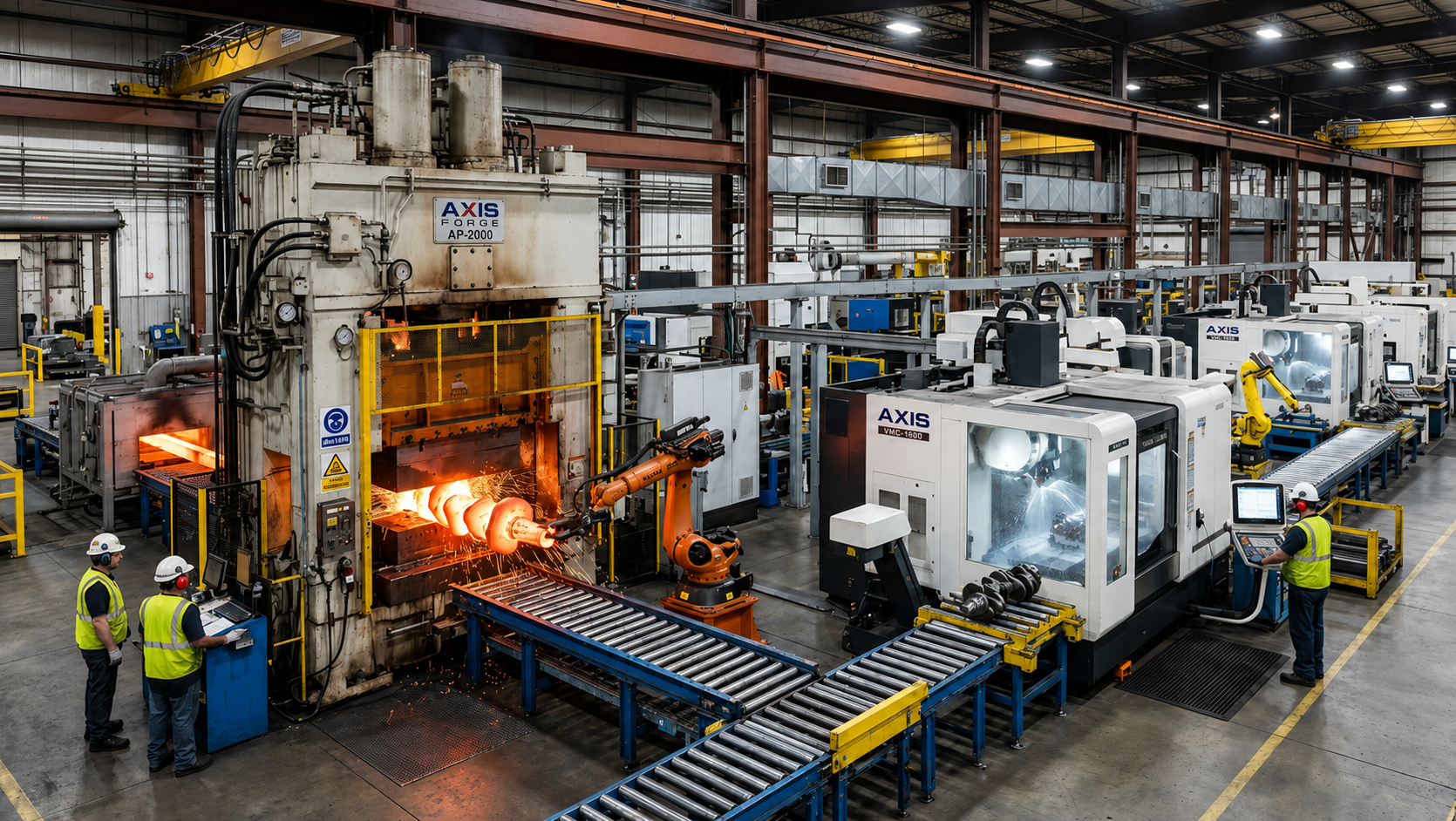
One partner manages every production stage: raw material selection, forging, CNC machining, stamping, tube forming, finishing, and final validation — all under a single quality management system and a single program team accountable from RFQ to delivery.
How Is It Different From a Single-Process Vendor?
A single-process vendor owns one step and hands the part off. An end-to-end automotive component manufacturer owns the chain, so tolerances, logistics, and accountability stay with one supplier from quote to delivery — eliminating the inter-supplier gaps where most quality events originate.
How End-to-End Sourcing Lowers Total Cost
The savings come from removing duplicated effort between vendors. Integrated development has been shown to cut R&D cost per vehicle by roughly 40% versus outsourcing, and consolidating component interfaces can roughly halve per-vehicle cost. Fewer suppliers mean fewer POs, less inbound freight, fewer inspection points, and tooling that doesn't change hands. See Research And Markets on OEM Cost-Reduction Strategy for the underlying data.
Five Reasons OEMs Prefer End-to-End Suppliers
These are not theoretical advantages — each one maps directly to a procurement pain point that fragmented multi-vendor supply chains create and integrated suppliers eliminate.
One automotive components supplier owns quality and delivery — no finger-pointing across the chain. When something needs correcting, there is one phone call, one CAPA, and one accountable program team.
Consolidated interfaces, freight, and inspection beat the headline piece price of fragmented sourcing. Fewer purchase orders, fewer inbound shipments, and fewer quality-hold events compound into significant total program cost reduction.
Coordinated process planning shortens PPAP and ramp timelines. When forging, machining, and stamping are managed under one program team, design changes and engineering iterations propagate without the delay of multi-vendor resequencing.
A single IATF 16949 system governs every step, from forging to finished assembly. Dimensional hand-offs between processes stay within one quality management system — eliminating the tolerance accumulation and documentation gaps that arise when parts cross supplier boundaries.
One accountable partner is easier to monitor, audit, and dual-plan than a sprawling vendor list. Capacity assurance, business continuity planning, and sub-tier oversight are all managed under a single supplier quality agreement — reducing the coordination overhead that grows non-linearly with every additional vendor.
What to Look for When Selecting an End-to-End Manufacturing Partner
Vet the breadth of in-house processes, certifications, capacity headroom, and PPAP capability before awarding any program. A genuine automotive metal parts manufacturer should run these processes internally rather than re-outsourcing them — see our quality and certifications page.
-
✓In-house process breadth — forging, CNC machining, stamping, and tube forming operated at the same certified facility, not sub-contracted and re-branded.
-
✓IATF 16949 certification — verified on the global registry with scope covering every process type and site relevant to your component program.
-
✓Full PPAP capability — Level 3 PPAP demonstrated from a prior comparable program: DFMEA, PFMEA, control plan, MSA, and Cpk ≥ 1.67 on critical dimensions.
-
✓Capacity headroom — confirmed against your peak production volume, with documented contingency for volume ramp and model-year change events.
-
✓OEM automotive parts supplier track record — direct OEM or Tier 1 program experience with references available and audit transparency demonstrated upfront.
-
✓Financial stability — Dun & Bradstreet score reviewed alongside recent capex investment trend; financially fragile suppliers are a supply chain time bomb on any program exceeding two years.
What Changes With EVs?
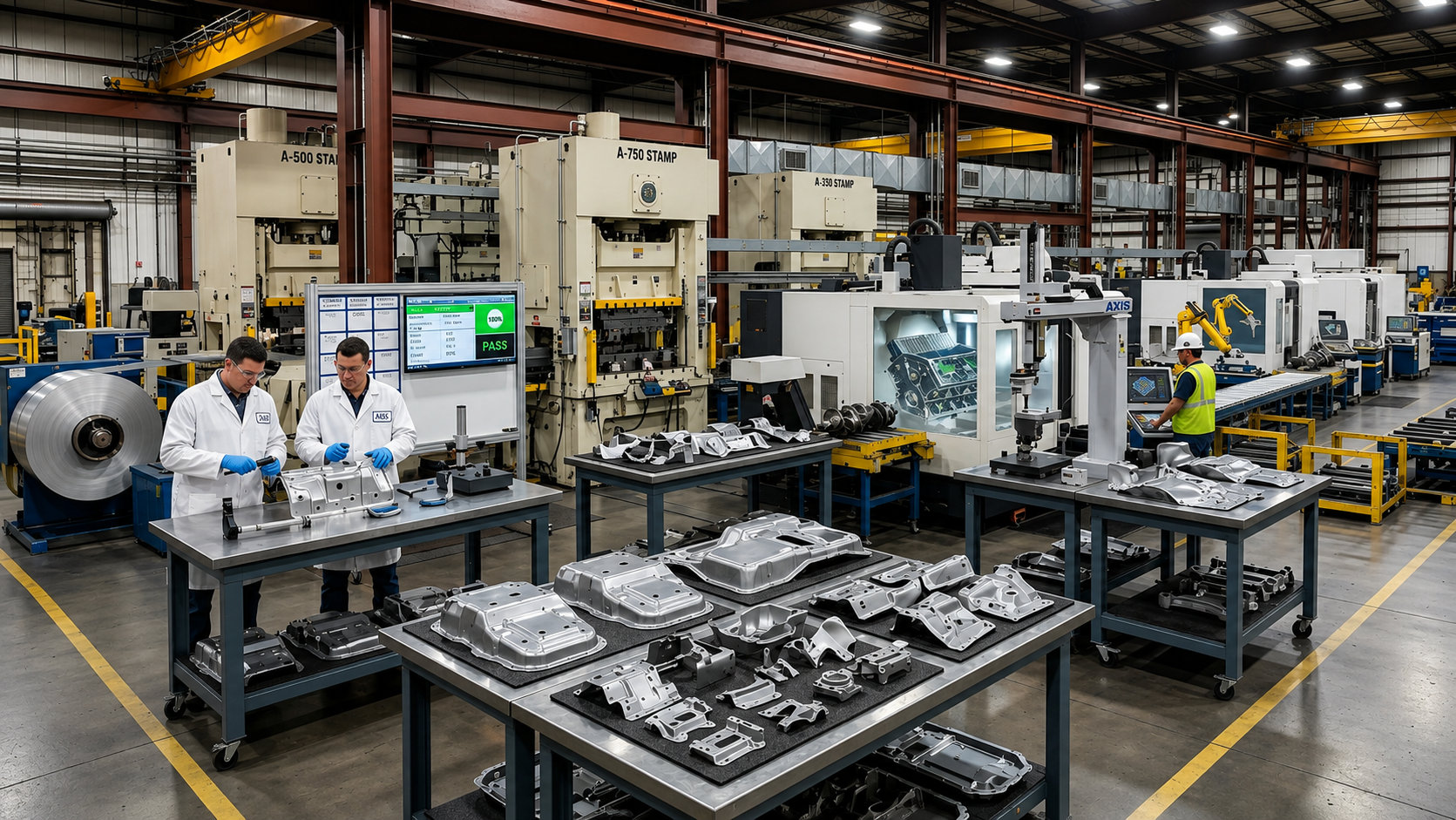
Electrification compresses program timelines and tightens margins, accelerating supplier rationalisation. OEMs launching new EV platforms want fewer, deeper supplier relationships that can absorb design iteration quickly — favouring partners who can forge, machine, and stamp structural and metal components without external handoffs.
Battery enclosure hardware, thermal management tube assemblies, and steer-by-wire actuator components are all genuinely novel component families where catalogue coverage is thin and co-development capability is not optional. The end-to-end supplier model is structurally better suited to EV program dynamics than fragmented single-process sourcing — because the design iteration cycles are faster, the engineering content is higher, and the cost pressure is greater.
The result is accelerating consolidation in the automotive supply base: OEMs are reducing the number of direct suppliers per program and deepening relationships with partners capable of handling multiple production stages. The end-to-end model is not a trend — it is the direction the industry is moving.
Frequently Asked Questions
Click any question to expand the answer.
It's a supplier that handles multiple production stages in-house — such as forging, CNC machining, stamping, and tube forming, plus finishing and validation — instead of the OEM coordinating several single-process vendors. The key distinction is that accountability for quality, delivery, and cost stays with one partner from quote to finished component.
It removes duplicated freight, purchase orders, inspection points, and tooling handoffs between vendors. Integrated development and interface consolidation have been shown to cut per-vehicle costs substantially — with R&D savings of approximately 40% and interface consolidation savings of approximately 50% documented in OEM cost-reduction research.
It concentrates volume, so it must be paired with capacity assurance and contingency planning. A single, well-audited partner is generally easier to monitor, audit, and dual-plan than a fragmented vendor base — provided the supplier's financial stability, capacity headroom, and sub-tier oversight are rigorously verified before program award.
IATF 16949 is the core automotive quality management standard — and the scope must cover every process and site relevant to your program, not just a headline certification. Depending on the component, customers may also require ISO 14001, material compliance documentation (REACH, RoHS, conflict minerals), and full Level 3 PPAP capability demonstrated on a prior comparable program.
Yes. A true automotive metal parts manufacturer runs these processes internally, keeping tolerances and accountability with one partner from quote to delivery. The key qualifier is "internally" — suppliers who claim end-to-end capability but sub-contract the processes they don't own in-house introduce the same accountability gaps as fragmented sourcing.
Use the RFQ form on the contact page and share drawings, volumes, and target timelines for a scoped response. Alternatively, email directly at sales@marimbaauto.com. Our engineering team reviews all RFQs and responds with a structured program assessment — not a generic quote.
Ready to consolidate your supply chain with an end-to-end manufacturing partner? Request an RFQ from Marimba Auto.
Request an RFQ →



