
Foreign Trade Zones Explained: How US Automotive Suppliers Offset Tariff Costs
Merchandise received into US foreign trade zones in 2024, with automotive the largest production sector
Section 232 tariff on covered auto parts, in effect since May 3, 2025
Section 301 duties on roughly 60 economies, effective July 24, 2026
What Is a Foreign Trade Zone?
Tariffs have become one of the largest and least predictable line items in an automotive program's cost model. Foreign trade zones are the tool most often cited as the answer. They still deliver real savings but for automotive specifically, several of the benefits buyers expect were removed by recent trade actions. Knowing which advantages survive is the difference between a working cost strategy and a quoted savings number that never materializes.
A foreign trade zone is a secure site inside the United States that, for customs purposes, sits outside US commerce. Goods can be admitted, stored, inspected, assembled, and manufactured without a formal customs entry. Duty is owed only when merchandise leaves the zone for US consumption. If it is re-exported instead, no duty is ever paid. Michigan's FTZ No. 70 in Detroit is one of the oldest and busiest zones in the country, and automotive is now the single largest sector by zone production activity.
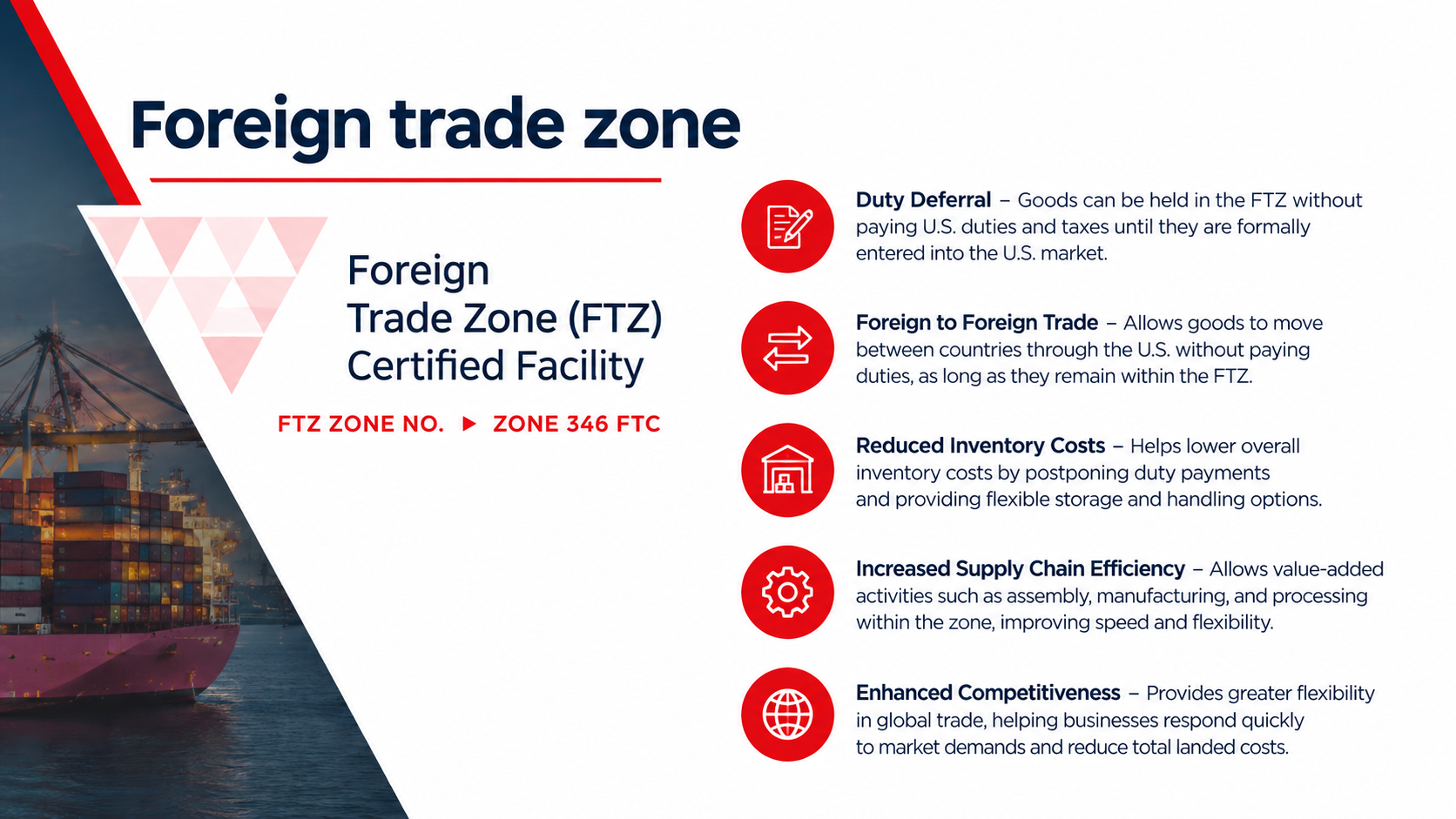
Marimba Auto (FTZ) Certified Facility
How FTZs Reduce Landed Cost
Five mechanisms do most of the work.
Cash stays in the business until goods actually ship to a customer, which matters on long inventory cycles.
Components admitted and later shipped abroad never incur US duty, and no drawback claim is needed.
Duty is owed on the material that leaves the zone, not on what was admitted. For forging and machining, where yield loss is significant, this is meaningful.
One entry per week instead of per shipment caps the merchandise processing fee and cuts brokerage overhead.
Historically, a manufacturer could elect the finished-good duty rate when it was lower than the rate on imported inputs.
"A foreign trade zone changes when and how much duty you pay. It does not change whether a Section 232 tariff applies."
What Changed for Automotive Suppliers?
Proclamation 10908 imposed a 25% Section 232 tariff on passenger vehicles and light truck parts, effective for parts on May 3, 2025. It also carried a specific FTZ provision: any covered automobile or part admitted to a zone on or after those dates must enter under privileged foreign status unless it qualifies for domestic status. Privileged foreign status fixes the classification and duty rate as of the admission date.
The practical effect is that the inverted tariff benefit disappears for covered parts. A manufacturer can no longer admit tariffed components, produce a finished assembly, and withdraw at a lower finished-good rate. Duty drawback is also unavailable for the Section 232 automotive tariff. Steel and aluminum articles carry the same privileged foreign status requirement under their own Section 232 proclamations.
Where Foreign Trade Zones Still Deliver Value
The remaining benefits are cashflow and administrative rather than rate reduction, and they are still substantial for high-volume programs. Deferral improves working capital on imported raw stock. Export elimination is untouched and matters for suppliers shipping assemblies to plants abroad. Scrap relief and weekly entry compound quietly across thousands of shipments. What has changed is that a zone strategy now needs to be modeled against a specific bill of material and country of origin — not assumed. USMCA-qualifying content from Mexico and Canada enters at zero, which often makes origin planning a bigger lever than zone status.
Why Domestic Capability Is the More Durable Tariff Hedge
Every mechanism above depends on trade policy that has changed repeatedly across two administrations and several court rulings. Domestic content does not. Sourcing from a U.S. automotive parts manufacturer with in-house forging, CNC machining, stamping, and tube forming removes the exposure rather than deferring it. For buyers rebalancing away from tariffed supply, working with a custom automotive parts manufacturer based in Michigan converts a policy variable into a fixed, quotable cost. Our post on why OEMs prefer end-to-end suppliers covers the consolidation case in more detail.
Frequently Asked Questions
Click any question to expand the answer.
A foreign trade zone is a secure US site that is treated as outside US customs territory. Goods can be admitted, stored, and manufactured there without a formal customs entry, and duty becomes payable only when merchandise is withdrawn for US consumption. Goods re-exported from the zone never incur US duty.
No. An FTZ changes when duty is paid and can eliminate it on re-exported goods, but it does not exempt merchandise from Section 232 automotive tariffs. Covered parts must be admitted in privileged foreign status, which fixes the duty rate as of the admission date.
Privileged foreign status is an FTZ admission classification defined in 19 CFR 146.41 that locks a good's tariff classification and rate at the time of admission. Because Section 232 automotive, steel, and aluminum articles must be admitted this way, a manufacturer cannot later withdraw them at a lower finished-good rate.
No. Duty drawback is not available for the 25% Section 232 tariff imposed on automobiles and automobile parts. Suppliers relying on drawback as a recovery mechanism need to model tariff cost as a permanent landed-cost input instead.
It depends on volume, bill of material, and country of origin, but domestic content removes tariff exposure rather than deferring or managing it. For programs heavily weighted toward tariffed inputs, moving work to a US manufacturer often produces a more stable landed cost than a zone strategy subject to policy change.
Looking for a fixed, quotable landed cost instead of a moving tariff target? Contact us for your RFQ.
Request an RFQ →



