
When Should You Choose CNC Machining Over Forging for Automotive Parts?
Average material savings from forging vs machined-from-billet
Faster prototype iteration with CNC vs forging tooling
Higher fatigue life in forged vs equivalent cast components
Why the CNC Machining vs Forging Decision Matters More Than Most Teams Realize
Both CNC machining and forging are essential processes in automotive parts manufacturing — but choosing the wrong one for your component can cost you on tooling investment, unit price, lead time, and fatigue performance. In automotive parts manufacturing, process selection is not a back-office detail. It is a front-loaded engineering and commercial decision that locks in unit cost, tooling amortization, lead time, and structural performance for the entire life of a production program.
Choose the wrong process early, and no amount of supplier negotiation or design optimization will fully recover the efficiency or performance you left on the table. Yet process selection decisions are routinely made too late — after design freeze, when options are limited — or based on a supplier's available capability rather than the component's actual requirements. The result is over-specified forging tooling on low-volume components, or CNC-machined parts in fatigue-critical applications where forging grain structure is the only way to meet durability targets.
This guide gives OEM engineers and procurement teams a clear, technical framework for making the right call every time. When cold forged automotive components are non-negotiable, and when a hybrid process approach delivers the best of both. You will also know exactly what to ask your automotive parts manufacturer before committing to either route.
"The process decision is the most consequential engineering choice you make before production. It defines your cost structure, your fatigue margin, and your supply chain flexibility — all at once."
Understanding the Two Processes: A Technical Baseline
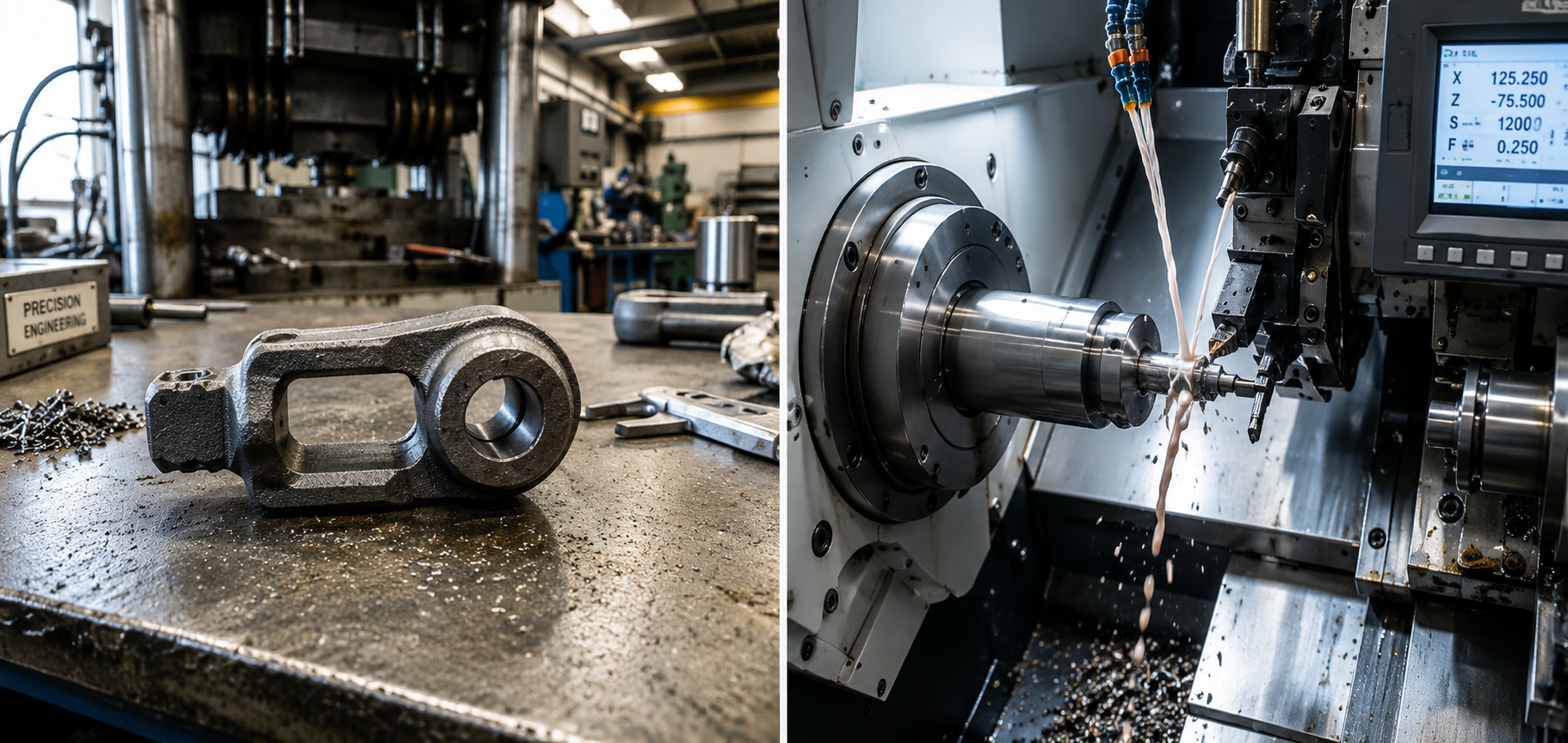
Before comparing them head-to-head, it is worth establishing precisely what each process does — because many sourcing decisions go wrong when the technical fundamentals are misunderstood or oversimplified.
What is CNC Machining for Automotive Parts?
CNC machining is a subtractive manufacturing process: material is removed from a billet, casting, or forging blank using computer-controlled cutting tools to produce a finished component geometry. Modern multi-axis CNC centers can hold tolerances to ±0.005mm or finer on complex aluminum and steel parts, making them the default process for precision automotive components where geometry accuracy, bore tolerances, and surface finish are the primary specifications. According to SME (Society of Manufacturing Engineers), CNC machining now accounts for over 55% of all metal component production across the automotive sector by value.
What is Forging for Automotive Parts?
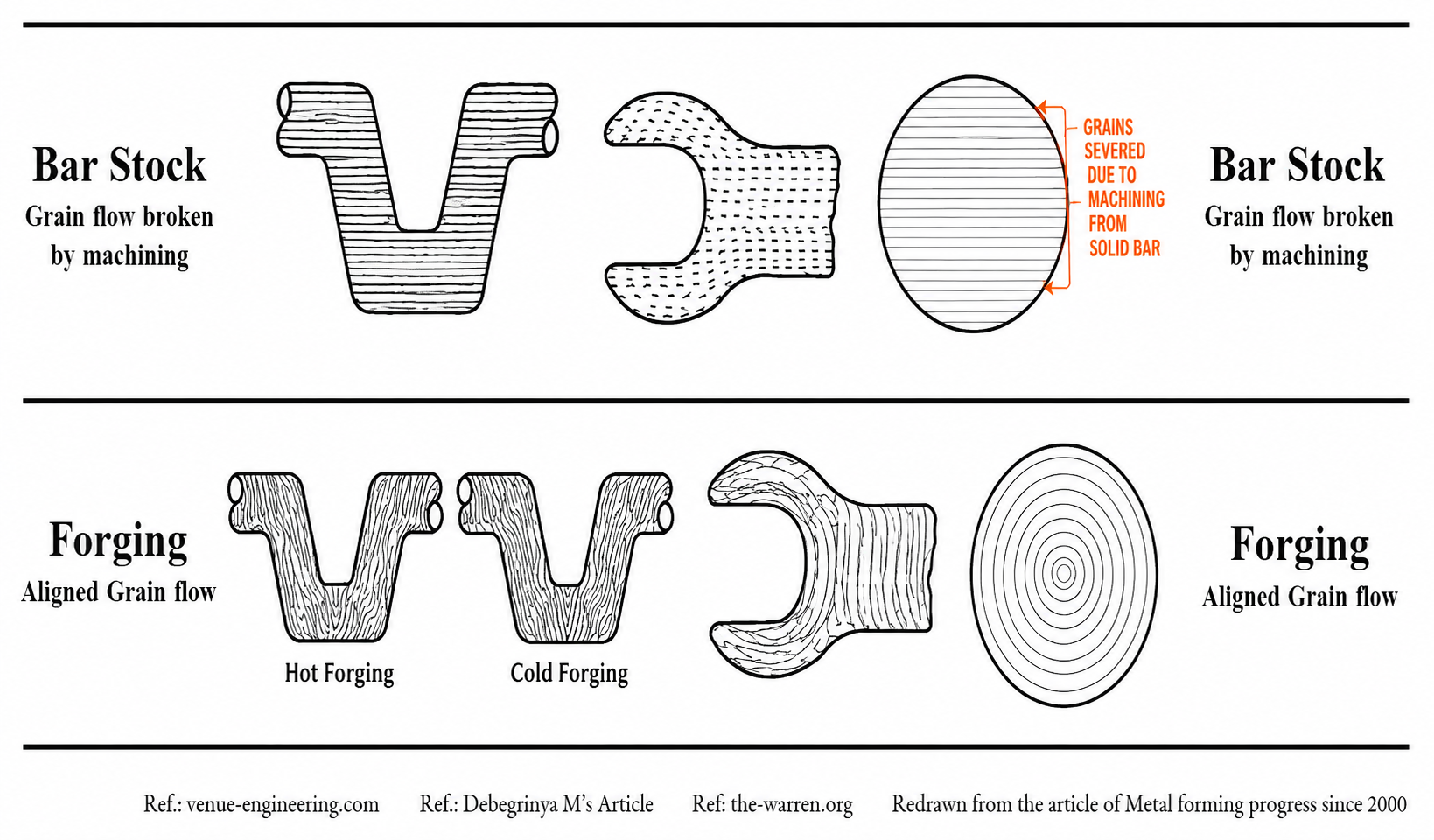
Forging is a compressive forming process: a metal billet is shaped under high pressure, either cold (at room temperature) or hot (above recrystallisation temperature), to produce a near-net-shape component. The compression process aligns the metal's grain structure to follow the component's geometry, producing a part with significantly higher fatigue resistance, tensile strength, and impact toughness than equivalent cast or machined-from-billet alternatives. A qualified forged automotive parts manufacturer can achieve material yield improvements of 15–30% over billet machining — a significant cost advantage at production volumes. The Forging Industry Association notes that forged components are specified for virtually every safety-critical automotive application where fatigue life is the primary design constraint.
CNC Machining vs Forging: A Head-to-Head Comparison
A full breakdown across the decision factors that matter most to OEM engineers and procurement teams.
| Decision Factor | CNC Machining | Forging |
|---|---|---|
| Tooling Investment | Low — no dedicated tooling; cutting programmed only | High — forging dies cost $20K–$200K+ depending on complexity |
| Unit Cost at Volume | Higher — material waste and cycle time increase with complexity | Lower — near-net-shape reduces material use and cycle time |
| Fatigue & Strength | Good — determined by material grade and heat treatment | Superior — aligned grain flow increases fatigue life 30–40%+ |
| Geometric Complexity | Excellent — 5-axis CNC handles almost any geometry including internal features | Limited by die draft angles and parting line constraints |
| Dimensional Precision | ±0.005mm achievable — ideal for bore tolerances and mating features | ±0.5mm typical for forged features; secondary machining required for tight tolerances |
| Lead Time (New Part) | Days to weeks — no hard tooling required | 8–20 weeks — die design, manufacture, and tryout required |
| Volume Break-Even | Preferred under ~500–2,000 parts/year depending on complexity | Preferred above ~2,000–5,000 parts/year where tooling amortizes |
| Design Change Flexibility | High — programmed update only; no tooling re-investment | Low — die modification or replacement required for geometry changes |
| Material Options | Widest range — aluminum, steel, titanium, exotic alloys, composites | Steel, aluminum, titanium — limited by formability at temperature |
| Surface Finish | Ra 0.4 µm achievable — best-in-class for functional surfaces | Ra 3.2–6.3 µm as-forged; secondary machining required for critical surfaces |
| Safety-Critical Suitability | Suitable with correct material and heat treatment specification | Preferred by most OEMs for highest-load safety-critical applications |
When to Choose CNC Machining for Automotive Components
CNC machining is the right answer when the component's requirements — geometry, precision, volume, lead time, or material — fall outside what forging can cost-effectively deliver. Understanding these scenarios clearly prevents over-investment in forging tooling where machining would serve the program better.
- ⇒Annual volumes are below 2,000–5,000 units and tooling ROI for forging cannot be justified.
- ⇒The component requires tight bore tolerances (±0.01mm or finer) that forging cannot achieve as produced.
- ⇒Internal features, undercuts, or thin-wall sections rule out die forging geometry constraints.
- ⇒The program is in development or prototype phase and design changes are expected.
- ⇒The part is machined from a forging or casting blank combining both processes.
- ⇒Exotic or specialty alloys are specified that are not forgeable at commercial cost.
- ⇒The component is an EPS housing, sensor mount, or structural bracket with complex geometry.
- ⇒The component is safety-critical and fatigue life is the primary design constraint.
- ⇒Annual volumes exceed 5,000+ units and tooling investment amortizes over the program life.
- ⇒Material savings from near-net-shape production provide meaningful cost advantage at volume.
- ⇒The part is a tie rod, control arm, knuckle, or shaft where grain structure integrity is non-negotiable.
- ⇒Weight reduction is required without sacrificing tensile or fatigue strength.
- ⇒The OEM specification explicitly requires forged construction for the component category.
- ⇒The component family has a stable, multi-year production run with low design change probability.
When a Hybrid Approach Delivers the Best of Both
Some components benefit from forging for structural integrity and CNC machining for precision surfaces. Here is when to consider combining both processes.
Forge the near-net shape to lock in grain structure, then machine to final tolerances. Common for knuckles, hubs, and transmission shafts requiring both fatigue performance and precision bore fits.
Start with CNC-machined parts during low-volume development and prototype phases, then transition to forged production tooling once volumes justify the investment. Protects program timing without locking in cost.
For complex geometries where forging draft angles are prohibitive, a cast near-net blank followed by CNC machining of critical surfaces offers a cost-effective middle path at mid-volume production rates.
The most valuable time to evaluate process selection is at RFQ stage — before die investment is locked. Request DFM analysis from your automotive parts manufacturer to compare both routes against your program's actual volume and fatigue requirements.
Questions to Ask Your Automotive Parts Manufacturer Before Committing
- Can you model total cost of ownership across both CNC and forging routes at our projected annual volume?
- What is your die tooling amortization threshold and how does it change with program life assumptions?
- Do you hold IATF 16949 certification for both machining and forging operations?
- Can you supply fatigue test data comparing forged vs machined equivalents in this material grade?
- What is your lead time for prototype CNC parts, and does that extend to forged first-off samples?
- If volumes ramp beyond the break-even point, what is the transition plan from machined to forged production?
Marimba Auto offers both CNC machining and forging capability under one roof — allowing OEM and Tier 1 teams to make the right process decision for each component without being constrained by a single-process supplier's bias. Their engineering team provides DFM analysis and process recommendation at the RFQ stage, so program teams have the information they need before tooling decisions are locked.
Need a DFM analysis comparing CNC machining vs forging for your next component program?
Get in touch →



