
How to Select an Automotive Manufacturing Supplier That Meets IATF 16949 Standards
IATF 16949 certified sites globally as of 2024
Of automotive recalls traced to supplier quality failures
Higher re-qualification cost when supplier gaps surface post-award
Why IATF 16949 Certification Is the Starting Point — Not the Finish Line
IATF 16949 is the most widely referenced quality standard in automotive manufacturing — but a certificate alone tells you far less than most procurement teams believe. Knowing how to read it, verify it, and use it as the starting point rather than the endpoint of supplier evaluation is the difference between a qualified supply chain and a compliant-looking one.
Every professional in automotive procurement knows that IATF 16949 certification is a baseline requirement for any serious automotive manufacturing supplier. What fewer teams apply consistently is the recognition that the certificate is a minimum threshold — it confirms a quality management system exists, not a guarantee that it will perform reliably on your specific component, at your required volume, under your program's timeline pressure.
The global IATF registry currently lists over 75,000 certified sites. That number includes some of the most capable manufacturers in the world — and it also includes suppliers who passed their last surveillance audit with a handful of minor findings and have not improved their process capability since. The certificate does not distinguish between them. Your qualification process must.
This guide gives OEM procurement teams and automotive component manufacturer sourcing leads the framework to go beyond the certificate — verifying what it actually covers, auditing what it implies, and building a supplier evaluation process that correctly identifies the manufacturers your program can genuinely rely on from launch through production.
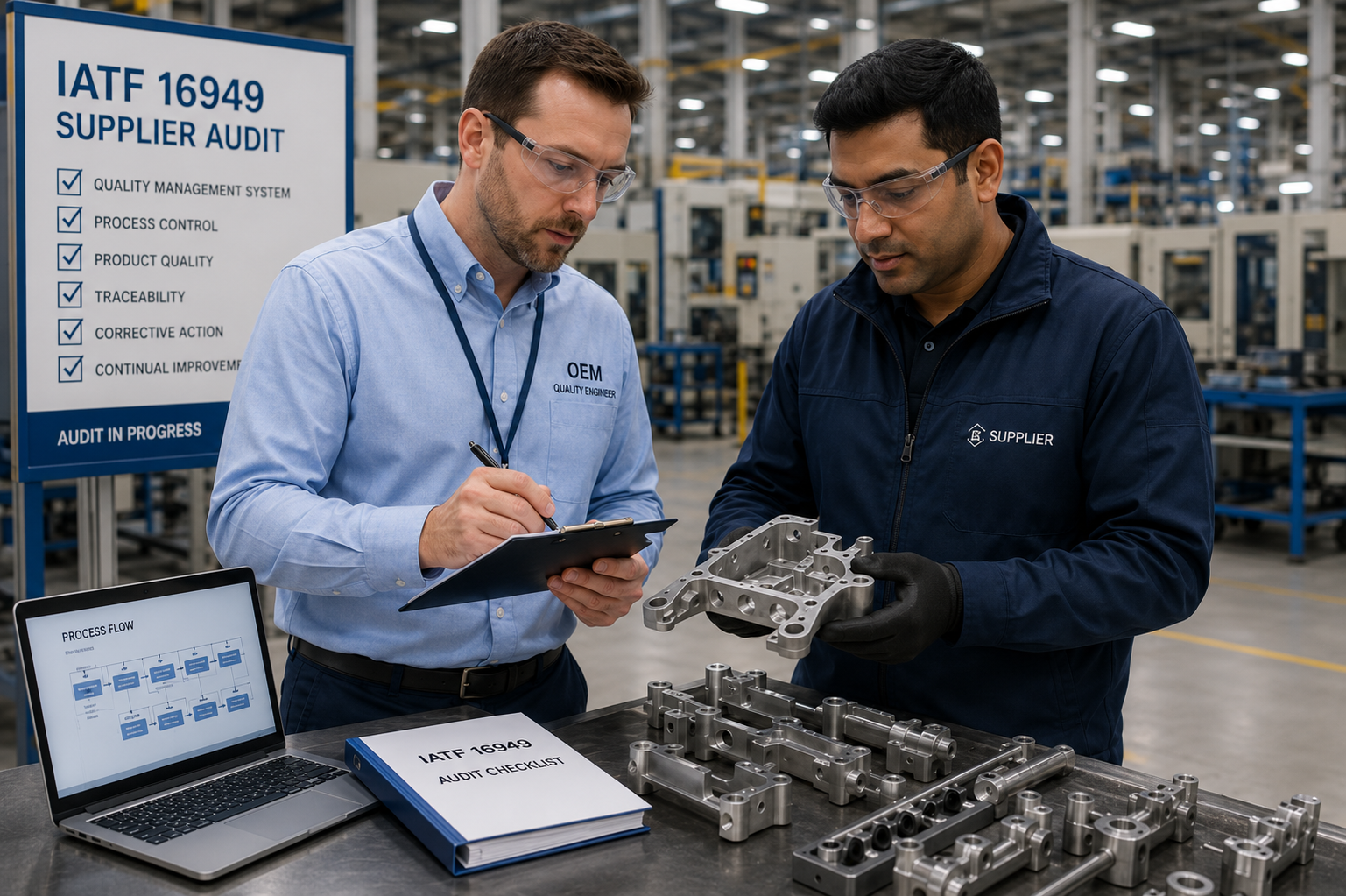
"An IATF 16949 certificate tells you a supplier has a quality management system. What it does not tell you is whether that system is any good. That is your job to find out."
Understanding What IATF 16949 Actually Certifies
Before using IATF 16949 as a supplier evaluation criterion, it is essential to understand precisely what the standard does and does not cover — because the gaps between what most teams assume and what the certificate actually confirms are where supplier quality failures originate.
IATF 16949 is a quality management system standard, not a product quality standard. It certifies that a supplier has documented processes for planning, producing, controlling, and improving their manufacturing operations. It does not certify that a specific component they produce meets your dimensional, material, or performance specification — that requires PPAP. It does not certify that their process capability is adequate for your tolerances — that requires a Cpk study. And critically, it does not certify that their capability extends to every process they claim, because IATF 16949 certification is scope-specific, site-specific, and process-specific.
A supplier can hold a current IATF 16949 certificate that covers CNC machining at their Michigan facility but not forging at their Ohio site, or that covers passenger car components but not commercial vehicle applications. Reading the scope statement of a supplier's certificate — not just confirming it exists — is the single most overlooked step in the automotive supplier qualification process. For teams sourcing across multiple process types, our guide to CNC machining vs forging covers why process-specific scope matters so significantly to component quality outcomes.
The Seven-Stage Supplier Selection Framework for IATF-Compliant Manufacturers
A rigorous supplier selection process follows a structured sequence. Skipping or compressing stages — common under program timeline pressure — is the single most reliable predictor of supplier quality events post-launch.
Certificate Verification and Scope Review
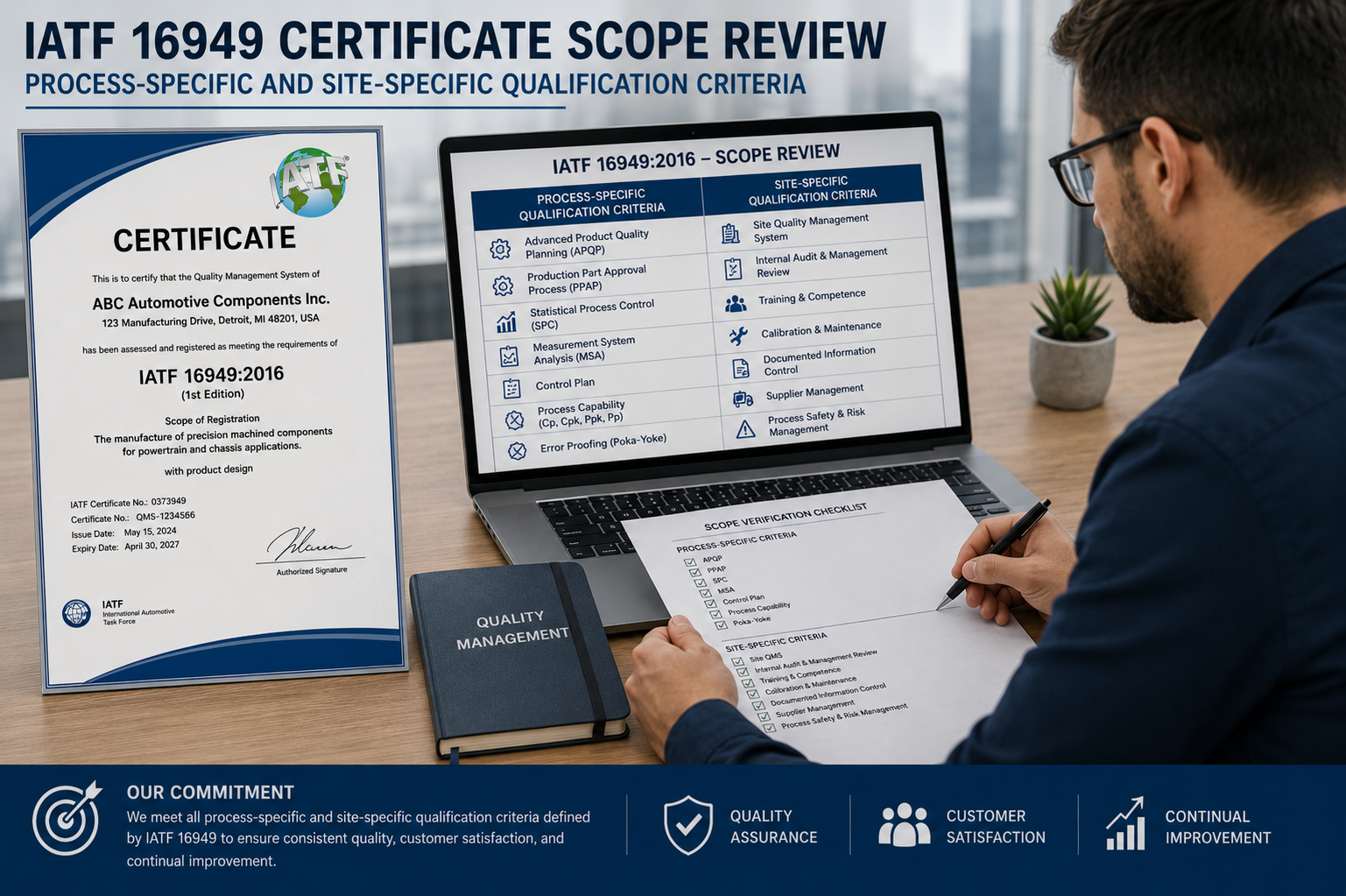
Never accept a supplier-supplied copy of their IATF certificate as the basis for qualification. Certificates can be outdated, suspended, or scoped differently than the supplier's marketing materials suggest. The correct approach is direct verification on the IATF global registry, cross-referencing the certificate number, expiry date, site address, and — most importantly — the scope statement. The scope should explicitly cover the manufacturing processes and product categories relevant to your component. If it does not, the certificate is not evidence of capability for your program.
PPAP Capability Assessment
The Production Part Approval Process is the mechanism through which IATF 16949's quality management principles are translated into component-specific evidence. For any safety-critical or precision component, require a Level 3 PPAP submission from a comparable prior program — same process family, similar material, and comparable dimensional complexity — before issuing a sourcing award. The PPAP package should include a completed DFMEA, PFMEA, control plan, MSA study, and initial capability study demonstrating Cpk of 1.67 or above on all critical dimensions. Suppliers who cannot produce a complete Level 3 PPAP from a prior program are not ready for safety-critical supply, regardless of what their certificate says.
On-Site Manufacturing Capability Audit
A desktop review of a supplier's quality documents tells you what their processes look like on paper. An on-site audit tells you what they look like in practice. For any Tier 1 automotive supplier components qualification, an on-site manufacturing audit is non-negotiable — and it should go beyond the quality management system to assess the actual production equipment, its condition and calibration status, the skill level of operators, and the real-time quality data being generated on the production floor. A capable automotive manufacturing supplier will not only welcome an on-site audit — they will facilitate it with a transparency that itself signals process confidence.
Process Capability and SPC Verification
IATF 16949 requires that suppliers control and monitor their manufacturing processes, but it does not specify at what capability level. A supplier can be fully IATF-compliant while running critical dimensional features at Cpk 1.10 — technically capable but with a defect rate that will generate warranty events across a million-unit production run. When qualifying an OEM automotive parts supplier, specify minimum Cpk requirements in your supplier quality agreement and verify current production data during the on-site audit.
Supply Chain and Sub-Tier Assessment
An automotive parts manufacturing company's quality management system extends to their sub-tier suppliers — but the depth of that extension varies enormously in practice. During qualification, map the supplier's critical sub-tier inputs: raw material sources, heat treatment if sub-contracted, surface coating, and any outsourced secondary operations. Confirm that sub-tier suppliers are also IATF 16949 certified or operating under the supplier's approved supplier list with documented qualification criteria. A single uncontrolled sub-tier supplier — a steel mill delivering out-of-spec material, a heat treater running incorrect process parameters — can generate a field failure that no on-site audit of the primary supplier would have caught.
Financial Health and Capacity Review
A quality management system cannot prevent a supplier from going out of business, running out of capacity, or making capital investment decisions that degrade their process capability over time. Financial instability in a supplier base is one of the most underweighted risks in automotive procurement — and for safety-critical components, a mid-program supplier failure is not a sourcing inconvenience, it is a production stoppage. Review Dun & Bradstreet ratings, recent capital investment history, and utilization rates before awarding any program that will run for more than two years. Our guide to custom vs standard supplier selection covers financial health assessment in the broader supplier evaluation context.
Supplier Quality Agreement and Ongoing Surveillance
Qualification is not a one-time event — it is the start of an ongoing quality relationship that must be actively managed. A formal supplier quality agreement should define minimum Cpk requirements by feature classification, PPAP levels for new and changed parts, escalation procedures for quality events, and surveillance audit frequency. Annual re-audits for Tier 1 suppliers and bi-annual reviews for critical Tier 2 sources are the OEM industry standard. Suppliers who resist ongoing surveillance or push back on quality agreement terms are signaling clearly that their confidence in their own process is not as high as their qualification submission suggested.
The Four Non-Negotiable Capabilities for Any IATF-Certified Automotive Supplier
Beyond the certificate and the seven-stage framework, these four operational capabilities separate genuine process discipline from compliance theatre. Verify each one during your on-site audit.
Statistical Process Control must be active and monitored in real time on all critical dimensions — not generated retrospectively for customer reviews. Ask to see the current SPC charts during your audit, not a prepared summary. Out-of-control signals with no documented reaction records are an immediate qualification concern.
Every component that carries a safety classification must be traceable — heat number, lot number, mill certificate — back to the raw material source. A supplier who cannot demonstrate this traceability chain on a sample component during your audit cannot support a recall investigation. This is a non-negotiable for any precision automotive components program.
DFMEA and PFMEA should be owned and maintained by the supplier's engineering function — not filed by the quality team and dusted off for customer audits. Ask who last updated the FMEA and what triggered the update. A living FMEA that reflects production learning is a strong signal of genuine process discipline. A static document last revised at PPAP is a risk indicator.
Review a sample of the supplier's recent 8D corrective action reports — ideally from a quality event on a program comparable to yours. Shallow root cause analysis that identifies symptoms rather than systemic causes, or corrective actions that are monitoring-based rather than process-change-based, indicate a quality system that manages failures rather than prevents recurrence.
Tier 1 vs Tier 2 Qualification: What Changes
The seven-stage framework applies to both tiers — but the emphasis and depth of specific elements changes depending on the tier relationship. Understanding these differences prevents both under-qualification of critical Tier 2 sources and over-qualification of commodity-level supply.
- ⇒Highest qualification stakes — full systems or assemblies delivered direct to OEM production line.
- ⇒Must demonstrate own process capability and visibility into sub-tier supply chains.
- ⇒System integration testing and interface validation required beyond component-level PPAP.
- ⇒Functional performance certification and OEM co-development relationship expected.
- ⇒ Annual surveillance audits by OEM are the industry standard. See our automotive suspension components guide for a Tier 1 qualification context example.
- ⇒Framework comparable in depth but narrower in scope — focused on the specific component family and process.
- ⇒Material traceability and Cpk requirements are equally rigorous as Tier 1.
- ⇒Failure mode may not become visible until it manifests at the Tier 1 system level.
- ⇒Sub-tier auditing by the OEM or Tier 1 team — not just reliance on the Tier 2's own IATF certificate — is standard practice on safety-classified programs.
- ⇒Bi-annual reviews are the minimum; safety-critical Tier 2 sources warrant annual surveillance.
Quick Audit Checklist: What to Verify on Every Supplier Visit
Bring this checklist to every on-site qualification audit. Any item the supplier cannot evidence on the day is a gap that requires resolution before program award.
- Current IATF 16949 certificate verified on the global registry — not a supplier-provided copy — with scope statement reviewed against your component's process and product category.
- Level 3 PPAP from a comparable prior program reviewed in full — DFMEA, PFMEA, control plan, MSA study, and Cpk ≥ 1.67 on critical dimensions.
- Live SPC charts viewed on the production floor for at least two critical dimensions — with documented reaction records for any out-of-control signals.
- Material traceability demonstrated on a sample production component — heat number and mill certificate to finished part.
- FMEA ownership confirmed as engineering-led — with evidence of update history tied to production events, not just PPAP submission.
- Sample 8D corrective action report reviewed — root cause depth and corrective action type (process change vs monitoring) assessed.
- Sub-tier approved supplier list reviewed — critical inputs identified and sub-tier qualification status confirmed.
- Supplier quality agreement discussed — willingness to commit to minimum Cpk, PPAP levels, and ongoing surveillance schedule confirmed.
Ready to qualify a supplier that meets the full depth of IATF 16949 requirements? Talk to Marimba Auto.
Get in touch →



