
What Are Automotive Fluid Carrying Components? Types, Applications and Manufacturing Process
Global automotive fluid systems market projected by 2029
Fluid-carrying tubes, lines, and assemblies per modern vehicle
Of field failures traced back to fluid line and tube component issues
Why the Fluid Carrying Component Decision Matters More Than Most Teams Realize
Automotive fluid-carrying components are routinely treated as commodity hardware — formed conduits that connect two points in the vehicle. That framing is exactly how programs end up with field failures that trace back through the supply chain to a manufacturing decision made years earlier: a material grade not properly validated, a bend radius that induced residual stress, or a fitting that was never leak-tested under representative conditions.
The stakes are significant. A brake line that loses pressure integrity is a safety event. A fuel line that cracks under thermal cycling is a fire risk. A coolant tube that fails at a fitting under vibration fatigue is an engine-damage event. In every case the failure mode was set upstream — which is why OEM teams need a clear understanding of what separates a capable automotive fluid handling components supplier from a generalist fabricator quoting on tube work.
This guide covers what these components are, the main types, where they are applied, and the manufacturing process behind them. For teams thinking about how upstream process choices affect performance, our guide to CNC machining vs forging for automotive parts covers the broader decision framework.
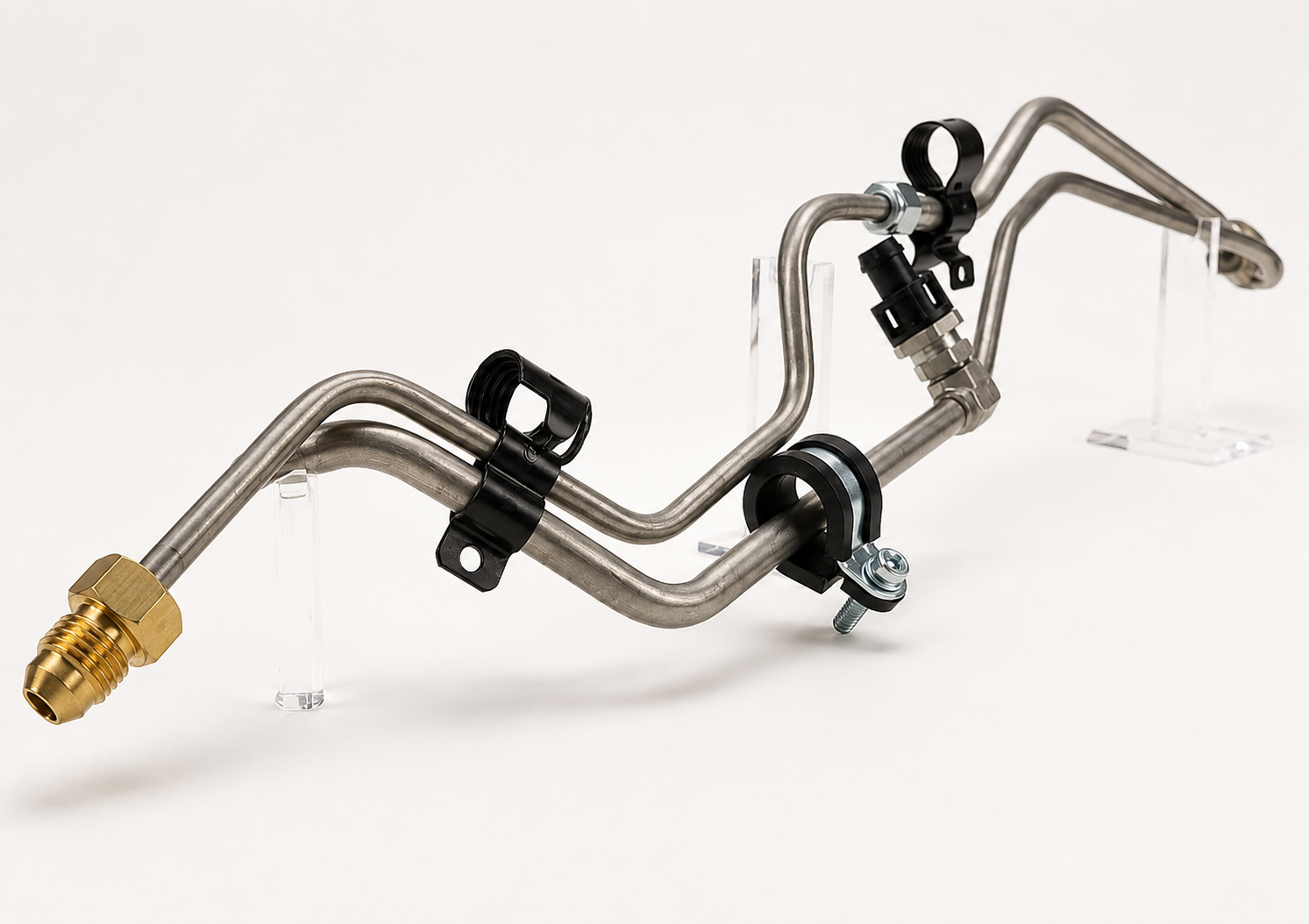
Fluid Handling Lines
"Every fluid-carrying component in a vehicle is quietly doing a critical job. The manufacturing decisions made upstream are the only reason it keeps doing that job through 10 years and 150,000 miles."
Understanding the Components: A Technical Baseline
Before mapping types and applications, it is worth establishing precisely what these components do — because many sourcing decisions go wrong when the fundamentals are oversimplified.
What Are Automotive Fluid Carrying Components?
They are the network of conduits and fittings that route liquids and gases between reservoirs, pumps, valves, and heat exchangers. Unlike basic plumbing, they must survive engine heat, road vibration, chemical exposure, and constant pressure cycling for the full life of the vehicle. Each part is engineered to tight tolerances, which is why automakers source them from a specialised custom automotive fluid carrying components supplier that can tailor geometry, material, and connection type to a specific platform.
Why Are They Harder to Manufacture Than They Look?
A tube component may look like a simple formed conduit, but most dimensional and structural failures originate at bends, flares, and formed ends — not in the straight runs. A flare angle 2° out of specification may pass an initial leak test, then generate a fatigue crack at the sealing interface after years of vibration and thermal cycling. This is why a credible automotive tube components manufacturer treats forming and end-forming as the most critical operations to control.
Types of Automotive Fluid Carrying Components
Every fluid system in the modern vehicle has distinct material, pressure, and environmental requirements. Understanding the component landscape is the first step to identifying the right supplier capability for your program.
| Component Type | Typical Material | Critical Manufacturing Requirement | Risk Level |
|---|---|---|---|
| Brake Lines | Double-wall steel (Bundy), stainless steel | Helium leak test, flare geometry validation, zinc-nickel coating | Safety Critical |
| High-pressure fuel rail | Stainless steel, high-strength steel | Burst pressure test, 100% helium leak test, surface finish on injector bores | Safety Critical |
| Low-pressure fuel lines | Nylon PA12, PTFE-lined, steel with nylon overcoat | Chemical compatibility validation, permeation testing, fitting pull-out force | High Precision |
| Coolant tubes (aluminum) | Aluminum alloy (6061, 6063) | Thermal cycling fatigue test, joint corrosion validation, pressure decay leak test | High Precision |
| EGR / turbo intercooler | Stainless steel, heat-resistant aluminum | Thermal distortion qualification, vibration fatigue test, weld integrity inspection | High Precision |
| Battery thermal mgmt. (EV) | Aluminum alloy, reinforced polymer | Ultra-low leak rate, glycol compatibility, dimensional precision at manifold interfaces | Safety Critical |
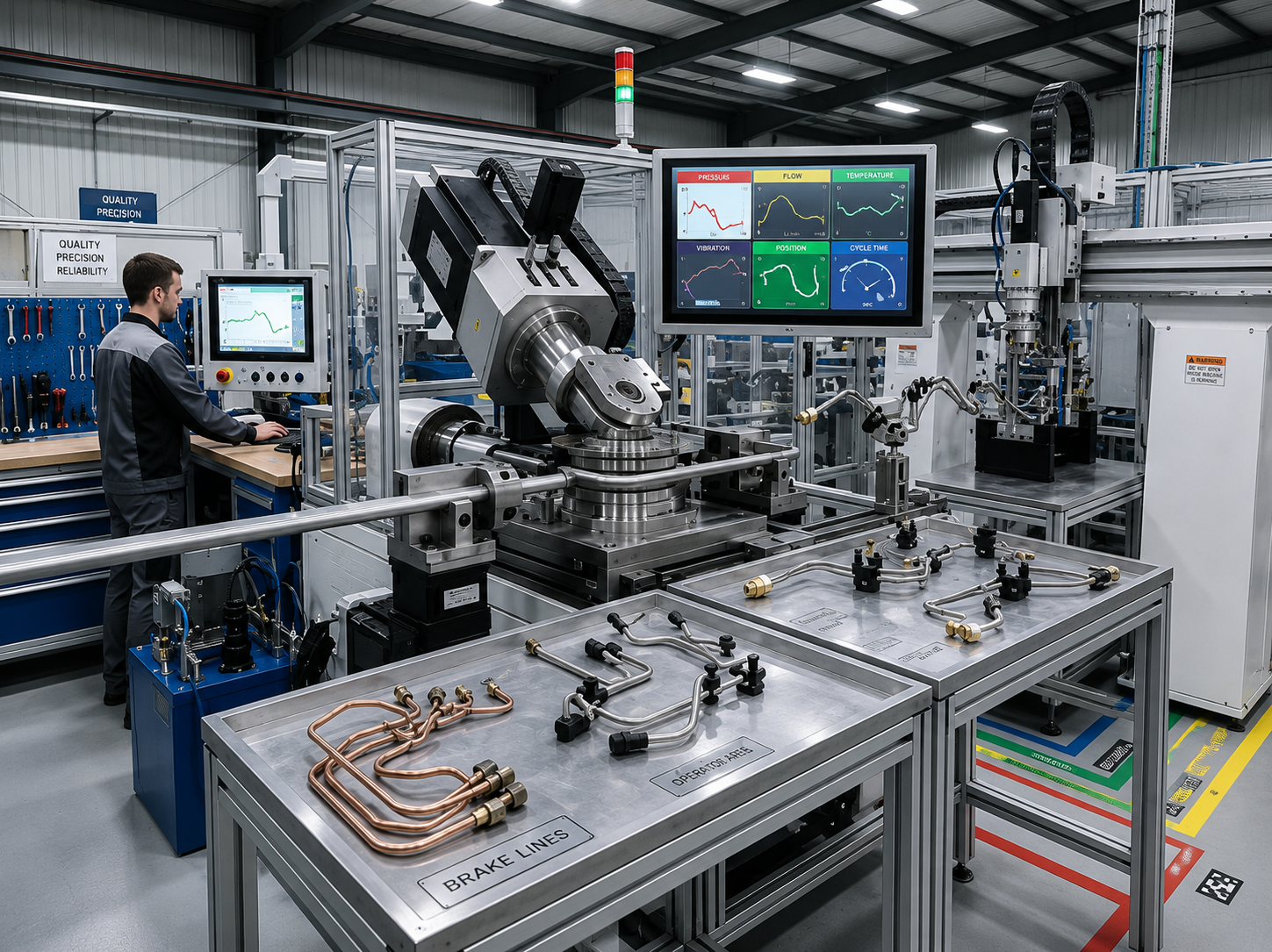
Types of automotive-fluid-carrying components: fuel, brake, coolant and transmission lines.
Applications Across the Vehicle
Fluid carrying components appear in nearly every system of the vehicle, and each application changes the material, wall thickness, and connection requirement.
-
⇒
Brake and hydraulic systems — the highest pressures in the fluid system, demanding leak-free flare connections and rigorous burst pressure testing before OEM approval.
-
⇒
Fuel delivery — chemically aggressive, with direct-injection systems running 150–350 bar and strict SAE permeation resistance requirements governing every design decision.
-
⇒
Cooling and HVAC — the widest temperature range of any fluid system, from -40°C cold starts to 130°C in sustained operation, where thermal-cycling fatigue and joint corrosion are the dominant failure modes.
-
⇒
Transmission and power steering — hydraulic and lubricating fluids under sustained pressure, requiring tight fitting torque and seal validation across the operating temperature range.
-
⇒
EV battery thermal management — the fastest-growing segment, with leak-integrity requirements stricter than any legacy fluid application and glycol compatibility demands that require validated polymer and coating databases.
Where these lines must be secured against vibration and road impact, an automotive structural components manufacturer supplies the brackets and supports that hold the system together — which is why integrated suppliers who handle both fluid lines and structural mounting eliminate the inter-supplier quality gaps most failures trace back to.
The Four Manufacturing Capability Pillars Every Supplier Must Demonstrate
These are not generic quality checklist items — they are fluid-component-specific capability requirements that a fabrication generalist cannot fake their way through on audit day.
General certification is insufficient. The scope must explicitly cover tube forming, end forming, coating, and assembly at the production site — not a different process at a different facility. Verify directly on the IATF global registry.
Level 3 PPAP minimum: DFMEA, PFMEA, control plan, MSA study, and initial capability study with Cpk ≥ 1.67 on all critical bend, flare, and coating dimensions. Request from a comparable prior program before selection — not after award.
Helium mass spectrometry for brake and fuel lines — detecting leak rates as low as 10⁻⁹ cc/sec. Validated pressure decay for lower-criticality applications. Sampling-based leak testing is not acceptable for safety-critical components, full stop.
Full heat and lot traceability on tube material, coating chemistry, and assembly hardware — retained to support a recall investigation if required. Conflict-mineral compliance documentation required on all metallic inputs.
The Manufacturing Process, Step by Step
A qualified fluid carrying components manufacturer follows a disciplined sequence at every stage — from material selection through to 100% validated output. Here is what that looks like in practice.
Material Selection
Steel, stainless, aluminum, or polymer chosen against pressure, temperature, and corrosion requirements — cross-referenced to fluid compatibility and OEM-approved material specifications, including REACH and RoHS compliance for coatings.
Cutting and Forming
A skilled automotive tube components manufacturer uses rotary draw bending with mandrel support, controlling spring-back, wall thinning, and ovality under Statistical Process Control with Cpk targets of 1.67 or above on critical dimensions.
End Forming
Flaring, beading, and swaging validated with dedicated gauging on every production piece — not sampled inspection. The flare geometry on a brake line end fitting determines leak integrity across the entire service life of the vehicle.
Joining and Assembly
Brazing, welding, and crimping bond tubes, hoses, and fittings. Brackets from an automotive structural components manufacturer add mounting and vibration control — integrated under one program team to eliminate inter-supplier accountability gaps.
Coating and Surface Treatment
Zinc-nickel electroplating (1,000+ hours neutral salt spray resistance) or nylon over-coating (PA12/PA11) for aggressive environments — with validated process control, regular SAE J2547 salt spray testing, and full lot traceability on coating chemistry and bath parameters.
Leak and Pressure Validation
100% testing on every finished assembly — no exceptions, no sampling. The testing method is matched to the application's leak-integrity requirement: helium mass spectrometry for safety-critical lines, validated pressure decay for lower-criticality applications.
EV Platforms and the New Demands on Fluid Component Manufacturing
Electric vehicles are reshaping requirements faster than most legacy fluid-system suppliers are equipped to handle. Battery thermal management is the most significant new system — lithium-ion packs require uniform coolant distribution through aluminum or polymer tube networks with near-zero leak rates, because even micro-leaks degrade battery chemistry over time.
Where a conventional coolant tube might accept a pressure decay of 0.5 kPa over 30 seconds, EV battery-cooling circuits are increasingly specified to helium leak standards previously reserved for brake lines — because the consequences of glycol ingress into a battery cell are far more severe than a coolant top-up event.
EV Sourcing Checklist
When qualifying a fluid handling components supplier for EV programs, confirm:
- Leak-test infrastructure meets battery-cooling circuit specifications — not just conventional coolant standards. Helium mass spectrometry capability is the EV minimum.
- Materials and coatings are validated for battery-pack environments and include glycol-compatible polymers cross-referenced against your specific coolant formulation.
- Engineering expertise aligns with your platform's thermal-management architecture — not just conventional coolant tube production experience.
- PPAP capability study references a comparable EV battery cooling program — not a conventional coolant tube program at lower leak-integrity standards.
- Dimensional verification process accommodates the tighter manifold interface tolerances common in EV battery pack architectures.
Why OEMs and Tier 1 Suppliers Partner with Marimba Auto
Automotive fluid carrying components keep every vehicle running safely and efficiently — from rigid brake lines and flexible hoses to EV battery-cooling assemblies. Their performance is decided upstream: by material selection, precise forming, validated coatings, and 100% leak testing. Choosing the right manufacturing partner is the leverage point.
Whether you need standard tubing or fully customised assemblies, Marimba Auto delivers the precision, documentation transparency, and integrated program management that OEM and Tier 1 programs demand — from prototype through full production launch.
Sourcing brake, fuel, coolant, or EV thermal management tube assemblies? Talk to Marimba Auto.
Get in touch →



