
What Are Automotive Suspension Systems?
Types, Components, and Functions
The suspension system is the unsung foundation of every vehicle — governing ride quality, handling precision, and occupant safety simultaneously. Here's everything engineers, OEM buyers, and procurement teams need to know.
Individual suspension components per vehicle on average
Global suspension components market by 2028
Of all recall events traced to suspension component failure
What Is an Automotive Suspension System?
An automotive suspension system is the network of springs, dampers, linkages, and structural components that connects a vehicle's body to its wheels. Its primary job is to absorb road irregularities — potholes, camber vibrations, surface transitions — while simultaneously maintaining tire contact with the road and delivering a controlled, predictable ride to the occupants.
Without a functioning suspension system, a vehicle would transmit every road imperfection directly to the chassis, tire contact would be inconsistent and dangerous, and the structural loads generated by driving would fatigue the body structure in a fraction of its intended lifespan. It is, in short, one of the most mechanically and dynamically critical systems on any vehicle.
For OEM buyers and automotive suspension components manufacturers, the system is also one of the most demanding to engineer and produce. Suspension components are safety-critical, load-bearing, and subject to millions of fatigue cycles over a vehicle's life — which is why precision, material quality, and manufacturing process control are non-negotiable at every tier of the supply chain.
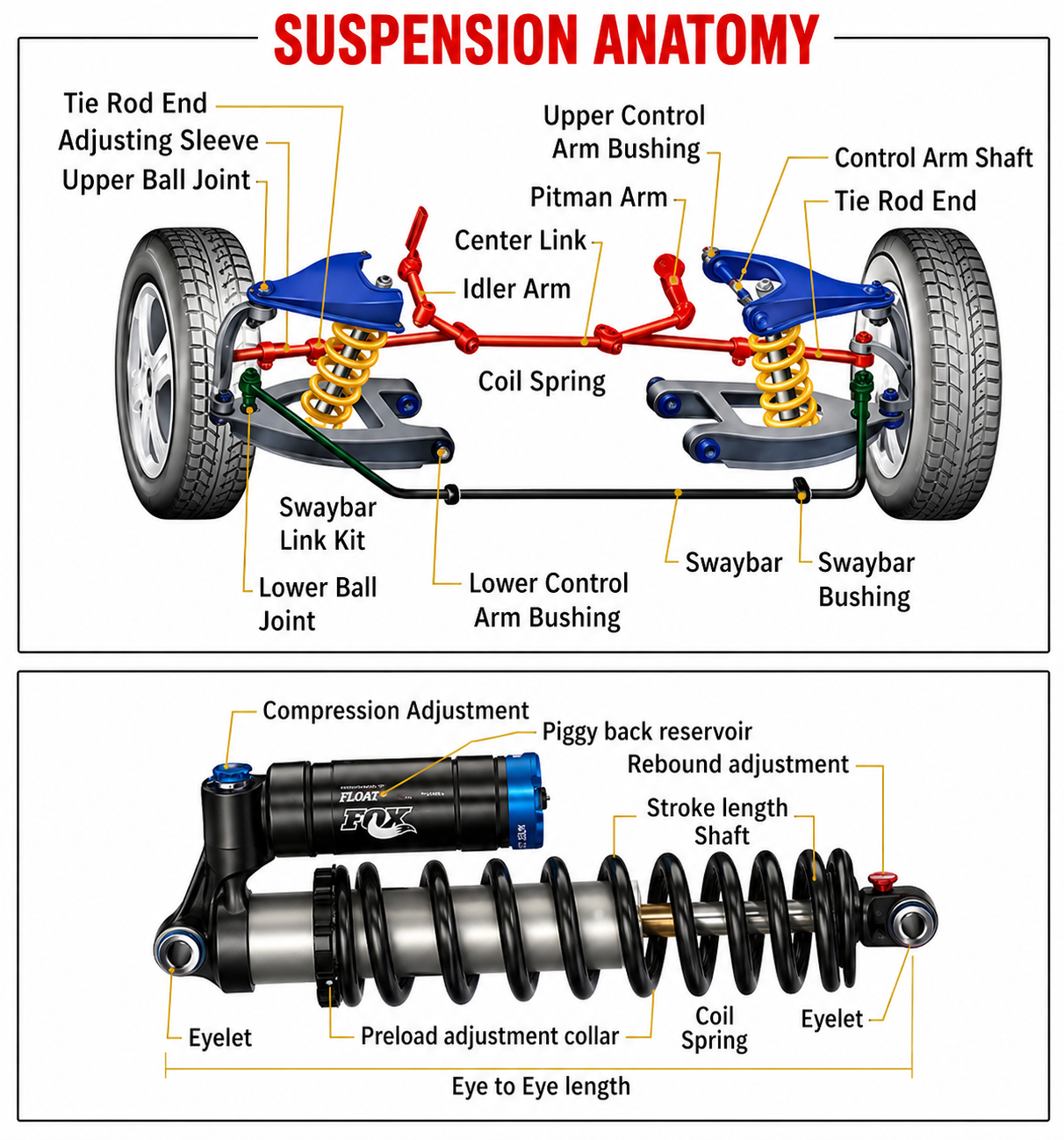
"A vehicle's suspension system doesn't just connect wheels to the body — it defines every dynamic characteristic the driver experiences. The quality of its components defines everything."
The Six Core Functions of a Suspension System
Every suspension design — regardless of architecture — must perform these six interdependent functions simultaneously. Understanding them is the foundation for evaluating how different suspension types and components are specified and sourced.
Absorb and dampen road inputs so they don't transmit to the vehicle body or occupants. Springs store energy; dampers dissipate it.
Maintain precise wheel alignment — camber, caster, toe — throughout the full suspension travel range to ensure handling predictability and tire life.
Maintain consistent tire-to-road contact under all conditions — acceleration, braking, cornering, and surface variation — to preserve grip and safety.
Resist body roll during cornering through anti-roll bars, geometry, and damper tuning to maintain vehicle attitude and lateral stability.
Support the vehicle's static and dynamic weight, including payload, passengers, and aerodynamic forces, without excessive deflection or distortion.
Attenuate noise, vibration, and harshness transmitted through the suspension structure via rubber bushings, hydro-mounts, and compliance joints.
Types of Automotive Suspension Systems
Automotive suspension architecture has evolved considerably over the past century, branching into independent, dependent, semi-independent, and electronically controlled families — each with distinct engineering trade-offs and component sourcing implications.
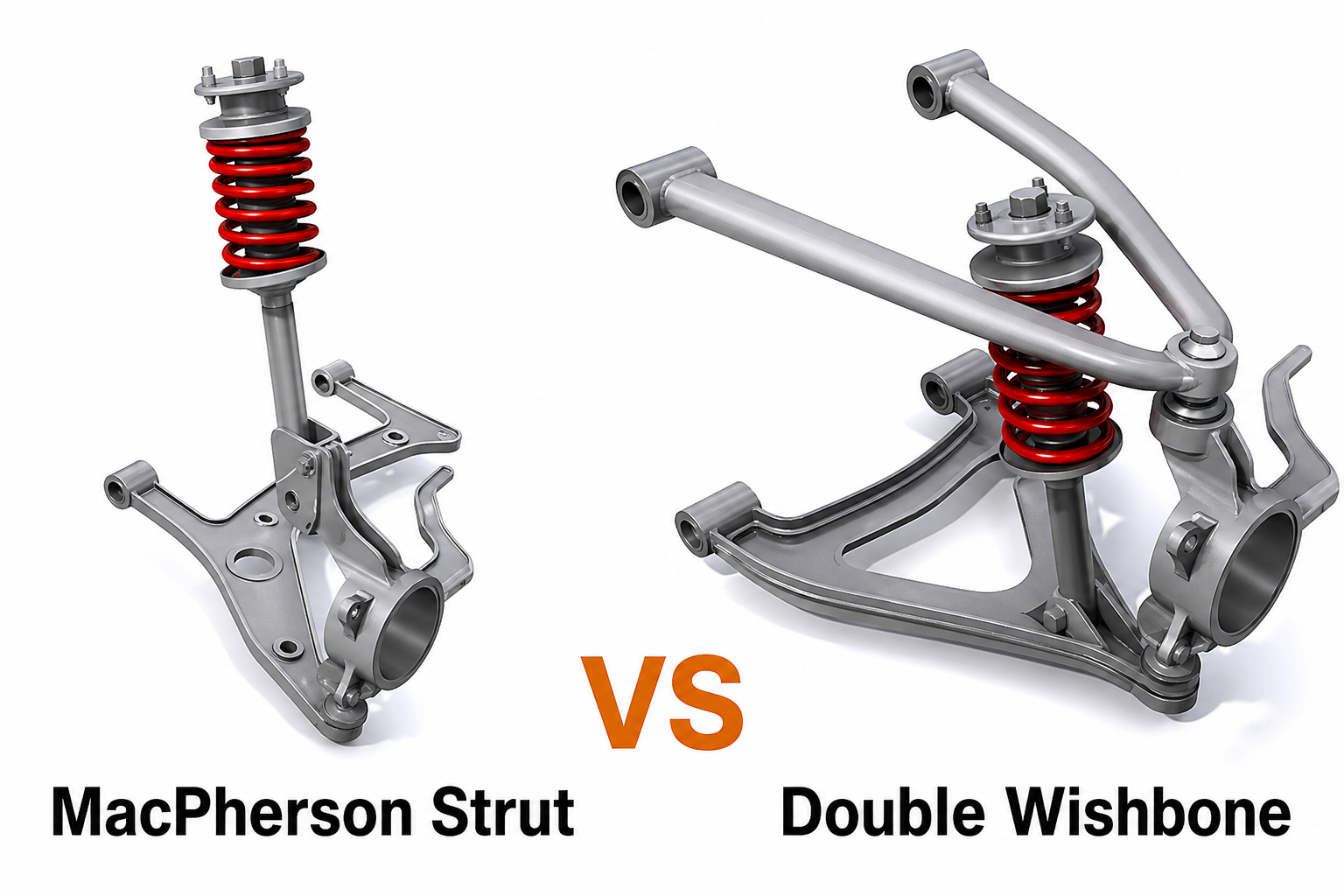
- ⇒MacPherson strut (Independent): The most widely used front suspension design globally. A single lower control arm with a combined spring-damper strut acting as the upper locating element. Cost-effective, compact, and well-suited for front-wheel-drive platforms. Components include the strut assembly, lower control arm, knuckle, and top mount bearing.
- ⇒Double wishbone / SLA (Independent): Upper and lower control arms provide superior camber control and geometry optimization across the full travel range. Preferred for performance vehicles, luxury sedans, and rear suspension on many platforms. Allows independent tuning of geometry and compliance through separate bushings and joints.
- ⇒Multi-link suspension (Independent): Uses three to five separate links per corner to independently control toe, camber, caster, and ride height. Found on most modern rear suspensions. The most component-intensive design and the most demanding for precision suspension components suppliers.
- ⇒Solid rear axle (Dependent): A rigid beam connecting both rear wheels — when one wheel moves, the other is affected. Robust, low-cost, and high-load-capacity, making it the standard for trucks, commercial vehicles, and SUVs. Leaf springs or coil springs locate the axle.
- ⇒Torsion beam / twist beam (Semi-Independent): A U or V section crossmember connects trailing arms on each side, allowing limited independent movement while providing a torsional roll-resistance function. Cost-effective for FWD rear axles in C-segment vehicles.
- ⇒Active / adaptive suspension (Electronic): Uses electronically controlled dampers, active anti-roll bars, or fully active hydraulic/pneumatic actuators to continuously adjust suspension response in real time. Found on luxury and performance platforms. Magneto-rheological dampers and air spring systems are the most common implementations.
Key Suspension Components and Their Functions
Every suspension system — regardless of type — is assembled from a set of core component families. For SAE-defined vehicle programs, each component carries its own specification, material, manufacturing process, and qualification requirements. Here is the complete reference for engineers and sourcing teams.
| Component | Function | Typical Material / Process |
|---|---|---|
| Coil Spring | Stores and releases energy from road inputs; supports static vehicle load | High-carbon spring steel, cold or hot coiled, shot-peened |
| Shock Absorber / Damper | Dissipates spring energy to control oscillation and maintain tire contact | Hydraulic or gas-charged monotube / twin-tube steel cylinder |
| Strut Assembly | Combined damper and structural upper locating element (MacPherson systems) | Steel tube with integrated damper; top mount bearing in aluminum or stamped steel |
| Control Arm (A-arm) | Locates the wheel hub laterally and longitudinally; guides suspension travel path | Stamped steel, forged steel, or cast/extruded aluminum |
| Steering Knuckle / Upright | Carries the wheel bearing, brake caliper mounting, and tie rod attachment point | Forged steel or cast iron (budget); forged or cast aluminum (performance/EV) |
| Ball Joint | Allows articulation between control arm and knuckle while transmitting load | Forged steel housing with PTFE-lined socket; requires fatigue certification |
| Tie Rod End | Transmits steering input from the rack to the knuckle; allows articulation | Cold forged or machined steel; threaded for alignment adjustment |
| Subframe / Cradle | Structural member mounting suspension links and powertrain to body; isolates NVH | Stamped and welded steel; increasingly hydroformed or cast aluminum |
| Anti-Roll Bar (ARB) | Resists body roll by torsional coupling left and right suspension sides | Solid or hollow spring steel bar; end links in forged steel or aluminum |
| Bushings and Mounts | Provide controlled compliance and NVH isolation at pivot points | Rubber-bonded steel; hydromounts for high-isolation applications |
| Wheel Bearing / Hub Unit | Supports wheel rotation while transmitting braking and lateral loads to knuckle | Sealed angular contact bearing unit; Gen 3 units integrate ABS tone ring |
OEM sourcing note: The components most frequently specified as safety-critical under IATF 16949 are ball joints, tie rod ends, steering knuckles, and control arms. These require full PPAP, FMEA documentation, and in many OEM programs, independent fatigue and corrosion test validation before production release.
For OEM and Tier 1 teams sourcing safety-critical suspension hardware, Marimba Auto manufactures precision forged and CNC machined suspension components including control arms, knuckles, and structural brackets to full IATF 16949 standards with documented PPAP and FMEA capability across every part family.
What to Look for in a Suspension Components Manufacturer
The specification of suspension components is only half the challenge. The other half is identifying a qualified manufacturer — one with the process capability, quality systems, and engineering depth to produce safety-critical parts at the precision, consistency, and volume your program demands.
Mandatory baseline. Verify the certificate is current and covers the specific manufacturing site and processes relevant to your component. Check the IATF global registry directly — don't rely on the supplier's own copy.
A forged knuckle supplier must demonstrate press capacity, die design capability, and in-house heat treatment. A stamped control arm supplier needs transfer press capability, AHSS processing experience, and validated dimensional measurement systems.
For every safety-critical suspension component, insist on a completed DFMEA and PFMEA, and a full PPAP submission including MSA, capability studies (Cpk ≥ 1.67 on critical dimensions), and appearance sign-off where applicable.
Leading suspension components manufacturers either operate in-house test rigs or have established relationships with independent test facilities for road load simulation, corrosion, and endurance validation.
Full heat/lot traceability on all steel and aluminum inputs, with certified mill test reports retained. Non-negotiable for components subject to recall risk.
The best precision suspension components manufacturers bring DFM analysis, CAD/FEA capability, and prototype tooling in-house — reducing iteration cycles and program risk significantly.
Suspension Systems and the EV Transition: What's Changing
Electric vehicles are rewriting suspension specifications in three important ways. First, EV platforms are significantly heavier than equivalent ICE vehicles — battery packs add 300–600 kg to vehicle mass, placing higher static and dynamic loads on every suspension component. Springs, control arms, subframes, and bushings all require recalculation and often re-specification for EV duty cycles.
Second, EV platforms are skateboard architectures — the battery pack is structurally integrated into the floor, changing how the subframe attaches and how NVH loads are transmitted into the suspension system. This has driven significant demand for custom suspension subframe designs and custom automotive parts manufacturers who can co-engineer novel attachment and isolation solutions.
Third, the absence of engine noise in EVs dramatically raises occupant sensitivity to suspension NVH — road roar, bushing squeak, and impact harshness that ICE powertrain noise previously masked become primary customer quality concerns. This is pushing suspension component specifications — particularly bushing durometers, mount isolation, and damper valving — to new levels of precision.
"In an EV, the suspension is the loudest system in the vehicle. Components that were acceptable before become the primary quality failure mode. Specification tolerances are tightening across the board."
Suspension Components Sourcing: A Practical Checklist for OEM Teams
Whether you are sourcing from a Tier 1 automotive supplier for complete suspension corner modules, or directly qualifying a custom automotive parts manufacturer for platform-specific knuckles and control arms, use this evaluation checklist.
- ✓Map every suspension component to its safety criticality level before issuing any RFQ — this determines the qualification depth required.
- ✓Require IATF 16949 certification with site-specific scope covering your component category — general certification does not cover process-specific capability.
- ✓Validate sub-tier steel and aluminum supply: domestic sourcing, dual-qualified mills, and conflict mineral compliance documentation are increasingly OEM and regulatory requirements.
- ✓Audit forging, machining, or stamping capabilities on-site — paper capability claims and actual machine conditions routinely diverge.
- ✓For EV programs, explicitly flag increased static load requirements and NVH isolation targets in the component specification — legacy ICE suspension specs will not be adequate.
- ✓Specify material grade, heat treatment specification, and corrosion protection requirements explicitly in the drawing package — never leave these to supplier discretion.
Ready to source precision suspension components from a qualified, IATF 16949 certified manufacturer?
Get in touch →



